I applied to be part of the inaugural cohort of CoSeC Fellows in the summer of 2024, knowing that the opportunity aligned closely with both my career goals and my professional values. As somebody for whom community-developed software, simulation tools, and shared technical know-how are vitally important in my day-to-day research, I was particularly keen to apply and to become more deeply involved in the CoSeC model.
CoSeC, and the Scientific Computing Department (SCD) at STFC more generally, has already played an important role in my career development. My research focuses on modelling complex materials at the atomic and sub-atomic length scales, so CoSeC’s CCP5 and CCP9 communities—and their associated activities, workshops, and conferences—provide valuable opportunities for me to engage with others working in related areas. I have also previously benefitted from informal, direct support from experts within the SCD working on some of the software packages I use, so the Fellowship felt like a natural way both to give something back and to become more involved in a model of research support that I value highly.
One of the aspects of the Fellowship that I enjoyed most was the opportunity to act as an ambassador for the CoSeC model, and more broadly for sustainable software development in computational research. Community software and shared technical expertise are essential to modern simulation-led science, yet they are not always as visible as the scientific results they help to produce. The Fellowship gave me a valuable platform from which to advocate for the importance of robust, well-maintained, community-driven research software, and to highlight the people and structures that make this possible. I was especially pleased that this strand of my work was reflected during the Fellowship year in the publication of an article of mine in the Journal of Open Source Software, which provided a natural opportunity to promote the value of open, sustainable, and reusable scientific software.
The Fellowship also gave me opportunities to contribute more directly to training and knowledge exchange. In particular, I participated as a demonstrator in the CECAM/ALC/CCP9 Spectroscopy Masterclass, supporting researchers as they worked with advanced computational approaches for spectroscopy. I found this especially rewarding because it brought together several things that I care about deeply: technical problem-solving, community building, and helping others to develop confidence with new computational tools. It was also an excellent example of the wider CoSeC ethos in practice, connecting people, software, and expertise across disciplinary boundaries.
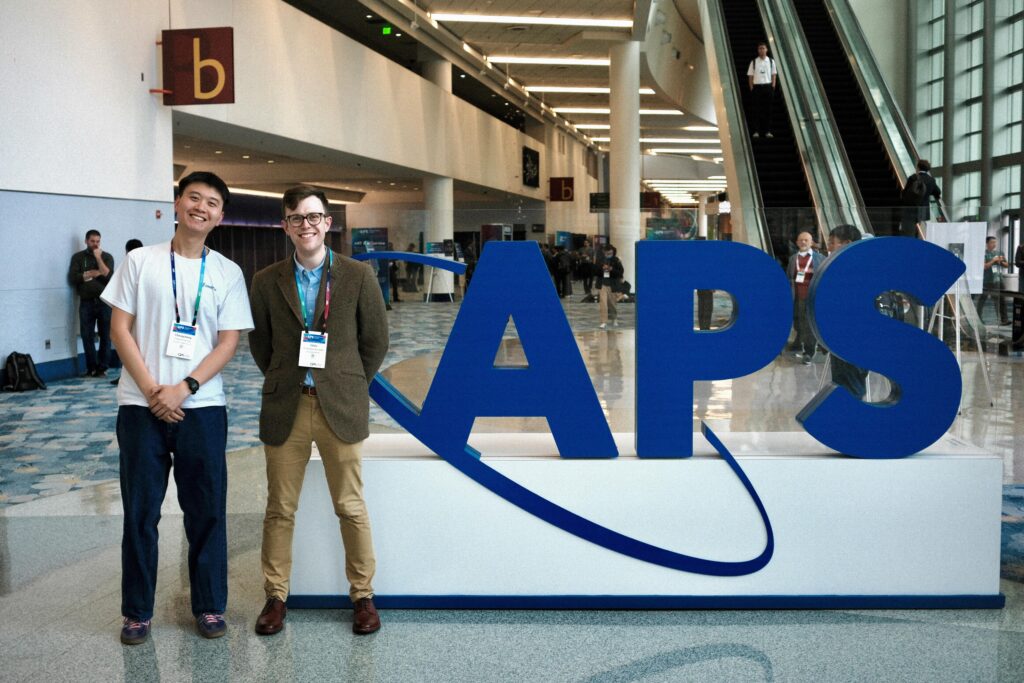
CoSeC 2025 Fellows Chengcheng Xiao (left) and Christopher Woodgate (right) at the APS Global Physics Summit, March 2025, Anaheim, CA, USA
Another major benefit of the Fellowship was the additional financial support that came with it. This made it possible for me to spread the word internationally in ways that would otherwise have been much more difficult. A particular highlight was my invited talk at the APS Global Physics Summit in March 2025, where I was able to share my research with an international audience. Opportunities such as this not only helped raise awareness of my own work, but also demonstrated the value of the broader community-supported computational ecosystem that CoSeC exists to champion.
Overall, the CoSeC Fellowship has raised my profile both within the University of Bristol and externally, while simultaneously giving me a stronger platform from which to advocate for sustainable software and community-centred computational research. I would strongly encourage others in similar positions to consider applying in future years. It is an excellent opportunity both to develop your own research profile and to contribute to something much bigger than one individual project.