Impact
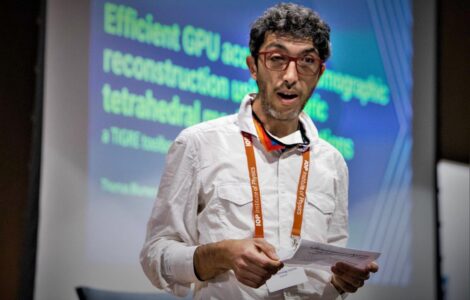
“CoSeC has helped us to create a community and has allowed us to develop software which otherwise would not be available”: An interview with CCPi Project Lead Edoardo Pasca
15 Oct 2026
HighlightsDr Edoardo Pasca is the Head of the Computed Tomography and Imaging group at Scientific Computing of STFC. He is also the Project Lead for the Collaborative Computional Project in…
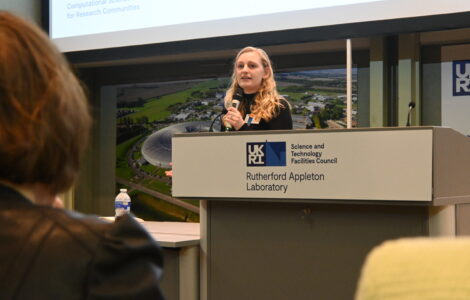
Jessica Huntley wins prestigious RSE Green Award
08 Oct 2026
Latest NewsSTFC Software Engineer Jessica Huntley has won the Green RSE Award at RSECon26, held from 9th-11th September in Sheffield. Jessica Huntley at the Energy Efficient Computing Workshop, September 2026 The…

Have Your Say: Take part in Understanding EDI in the UK DRI Community survey
18 Sep 2026
Latest NewsThe Computational Abilities Knowledge Exchange (CAKE) NetworkPlus supports collaboration and community building across the Digital Research Infrastructure (DRI) programme and the UK’s wider large-scale computing landscape. It acts as a central…

CoSeC announces Winner of 2026 Impact Award
16 Sep 2026
Latest NewsWe are delighted to announce the winner of this year’s CoSeC Impact Award. Following a panel process, CoSeC have awarded the 2026 CoSeC Impact Award to Mr Sunday Nwokolo, Bangor University…
Software Spotlight – September 2026
16 Sep 2026
Software SpotlightsDL_MESO is a general-purpose simulation package capable of modelling complex fluids, soft matter and transport phenomena using Dissipative Particle Dynamics (DPD) and Lattice Boltzmann Equation (LBE) methods, enabling efficient materials…
Software Spotlight – August 2026
12 Aug 2026
Software SpotlightsCRYSTAL is an ab initio electronic structure program, concentrating on density functional theory (DFT) for periodic systems. Unusually, the software uses a Gaussian Basis set. Read more about CRYSTAL and…
Software Spotlight – July 2026
16 Jul 2026
Software SpotlightsUSolv USolv is a machine learning approach to predicting protein crystal solvent content, which can be a key bottleneck in the protein structure solution pipeline. The models are based on the Vit-V-Net transformer and U-Net convolutional neural network architectures, developed using PyTorch in Python.

Addressing the UK’s clean energy goals: How multiscale computer modelling can benefit wind farms
09 Jul 2026
Case StudiesFrom turbulent ocean waves acting on offshore structures to detailed heat transfer within cryogenic systems, modern engineering and scientific challenges require increasingly sophisticated modelling that spans multiple physical domainsand time…