From turbulent ocean waves acting on offshore structures to detailed heat transfer within cryogenic systems, modern engineering and scientific challenges require increasingly sophisticated modelling that spans multiple physical domains
and time scales. STFC Scientific Computing’s CoSeC (Computational Science Centre for Research Communities) aims to create such modelling by delivering cutting-edge computational tools through collaborative computational projects (CCPs). One of these, CCP-WSI (Wave Structure Interaction), has collaborated on a code-coupling tool that not only directly addresses this challenge but will also hugely benefit the wind turbine industry in pursuit of renewable energy for a cleaner world.
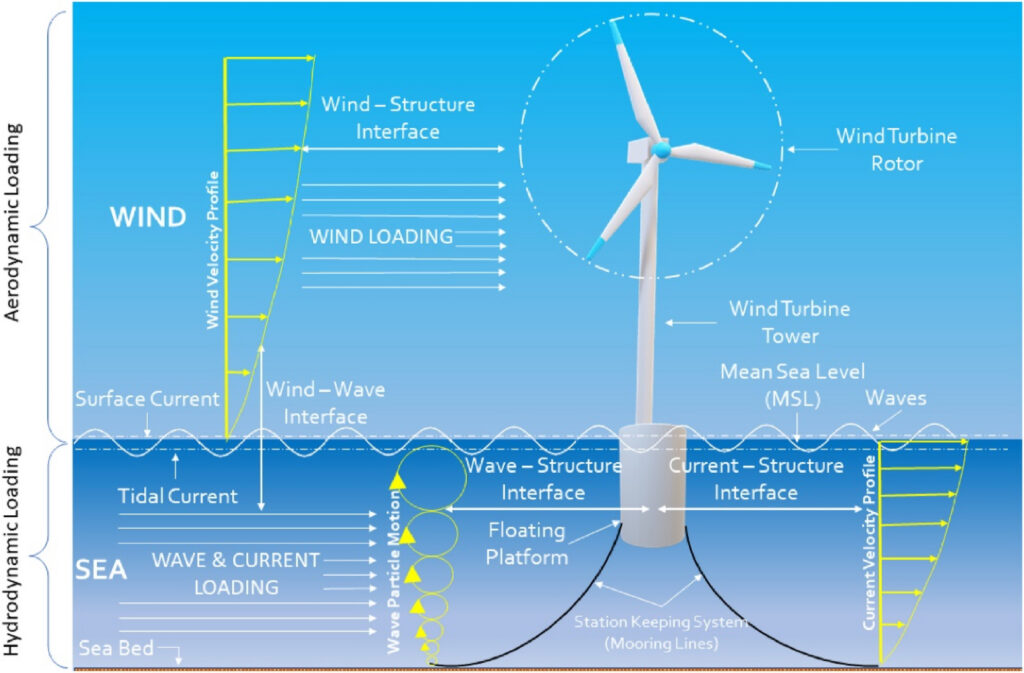
Floating wind turbines are more susceptible to loads such as wind and waves. They face a complex load condition, and their dynamic responses are difficult to predict. (Fig 1 – Clement et al. 2021)
The Challenge
The development of new computational models and the integration of new techniques, such as AI and machine learning, are required to meet the rising demand for adaptable modelling in traditional scientific and engineering simulations.
An effective way to achieve this is with simulation codes from different disciplines that work together by using solvers (programmes that use mathematical or logical problems to reach a solution). However, in practice, coupling solvers is often complex and time-consuming.
A solver is typically developed independently, with its own code architecture, numerical methods, data formats, and communication protocols. Therefore, enabling two codes to exchange data efficiently can require major code modification, undermine reproducibility and hinder progress across research communities.
The Approach
Multiscale Universal Interface (MUI) is one of the code coupling tools that can address this challenge. MUI provides a unified and efficient communication framework based on a message passing interface (MPI), which allows independently developed codes to exchange data during runtime. Its design ensures ease of integration and portability across computing environments.
Open Field Operation and Manipulation, known as OpenFOAM, is one of the world’s most widely used open-source computational fluid dynamics (CFD) software, with a global community of more than 25,000 users across academia and industry. It is the de facto standard in many CFD-based studies, ranging from aerodynamics and heat transfer to multiphase and ocean engineering applications.
Through CoSeC, the STFC MUI team worked closely with OpenFOAM developers at OpenCFD Ltd to lower the technical barriers for coupling this software with third-party simulation codes.
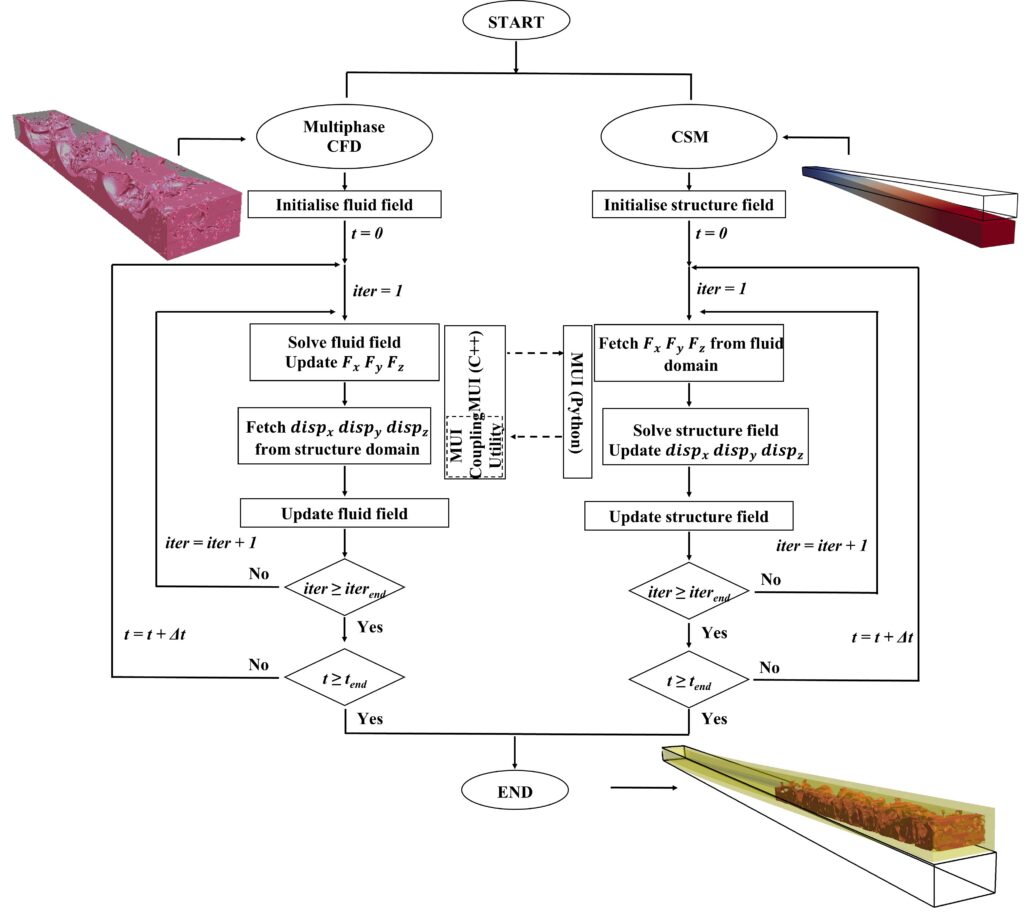
Schematic of the MUI-powered open-source framework. Image credit: W. Liu, O. A. Mahfoze, S. M. Longshaw, A. Skillen, D. R. Emerson, Simulating slosh induced damping, with application to aircraft wing-like structures, Applied Sciences 12 (17) (2022) 8481.
The Benefits
By enabling OpenFOAM-based solvers to connect directly with numerical frameworks through MUI, users can now perform multi-physics and multi-scale simulations. It simplifies intricate coupling workflows, removes the need for manual code adaptation, and allows simulations to be built, tested, and deployed efficiently across modern high-performance computing systems.
The convenient use of MUI in OpenFOAM has already facilitated a new code structure known as a ParaSiF (Parallel Partitioned Simulation Framework), which enables OpenFOAM to couple with other specialist solvers to capture complex interactions.
This new code structure not only makes it effortless to expand and meet the needs of different users but also can be easily maintained in the long run.
All codes used are of an open-source, community-oriented design that aligns with CoSeC’s mission to make advanced computing accessible across disciplines. It empowers researchers from diverse backgrounds to construct high-/multi-fidelity coupled simulations without the steep learning curve traditionally associated with high-performance computing.
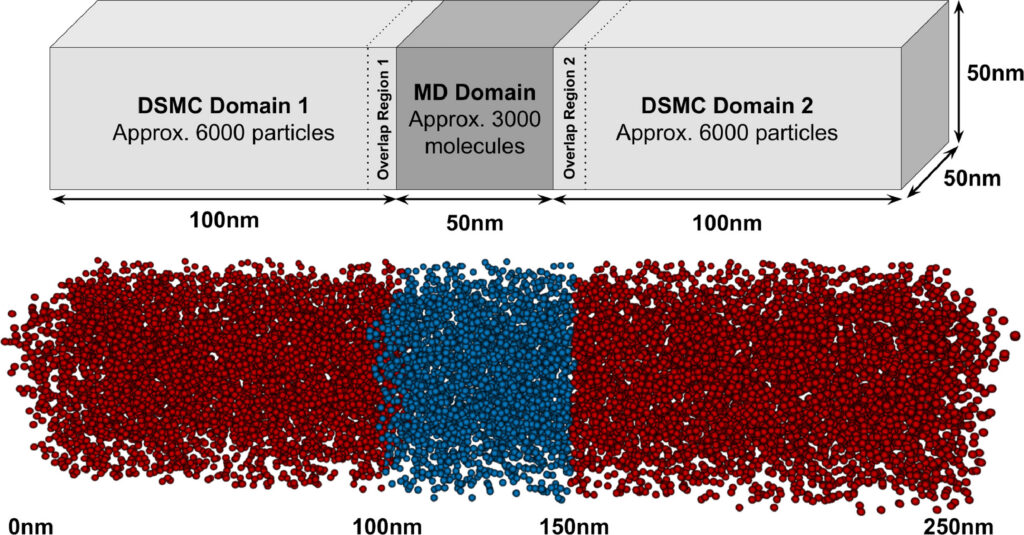
MUI enabled Molecular Dynamics to direct simulation Monte Carlo coupling. Image credit: S. Longshaw, R. Pillai, L. Gibelli, D. Emerson, D. Lockerby, Coupling molecular dynamics and direct simulation monte carlo using a general and high-performance code coupling library, Computers & Fluids 213 (2020) 104726.
Next steps
This new capability with ParaSIF is now being applied to the simulation of floating offshore wind turbine systems, where accurate modelling of coupled fluid–structure dynamics is essential to improve performance, safety, and resilience. Beyond renewable energy, this same approach will benefit not only the WSI community but also wider communities studying coastal and marine engineering applications.
By enabling codes like OpenFOAM and other widely used solvers to work together seamlessly, CCP-WSI and MUI
are helping to build a stronger, more connected research ecosystem capable of tackling the next generation of multi-physics and multi-scale challenges.
“By lowering the technical barriers, researchers are now able to focus on scientific and engineering insight rather than software integration. We are now supporting a growing ecosystem of advanced applications. As well as wave–structure interaction simulations for offshore and coastal engineering, we are now working on machine learning simulations, where models are integrated directly into physics-based solvers, developing heat transfer modelling for cryogenic systems, which is critical in
low-carbon aviation and maritime transport.” Wendi Liu, CoSeC Project Lead for CCP-WSI, STFC Scientific Computing