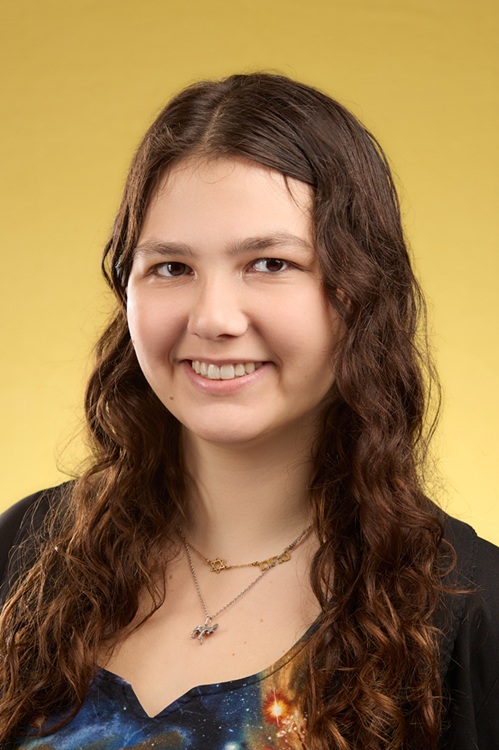
PhD candidate, University of Cambridge
Larom Segev is a PhD candidate at the University of Cambridge’s Cavendish Laboratory developing the receiver and calibration system for CosmoCube, an instrument headed to the Moon’s far side to detect one of the faintest signals in cosmology: the global 21-cm signal from the Cosmic Dark Ages, shielded there from terrestrial radio noise. This signal offers one of the only direct windows onto the period between the early universe becoming transparent to light and the formation of the first stars and galaxies; an otherwise inaccessible era that shaped how all cosmic structure later emerged. Because the signal is buried beneath competing radio emission thousands of times brighter, Larom’s work sits as much in software as in hardware: building simulations that predict what the instrument should see and checking these against real data to calibrate it.
This same pattern of a physical model, an instrument that distorts it, and simulation used to recover the true signal runs through several of Larom’s other collaborations: FPGA-based signal processing for an axion dark-matter search, detector readout for a cosmic microwave background mission, and real-time scheduling algorithms for the Vera C. Rubin Observatory’s all-sky survey. As a CoSeC Fellow, Larom wants to connect these problems with communities that already maintain mature simulation tools for closely related physics: UK Numerical Relativity for gravitational-wave modelling, CCP-DCM for signal and foreground simulation, and CCP-TEPP for particle-physics modelling, and to use the Fellowship to represent astronomical instrumentation, a domain not yet well represented among CoSeC’s communities, showing how the same simulate-to-validate approach these groups already use can help verify an instrument against reality.
Interesting fact: Larom represented early-career researchers at the United Nations’ Committee on the Peaceful Uses of Outer Space, where she raised issues including onboard satellite systems standardization and lunar radio-frequency interference regulation.