A challenge facing STFC Scientific Computing is delivering state-of-the-art software to institutions with outdated systems unable to accept the latest developments. Its Computational Science Centre for Research Communities (CoSeC) Programme can provide this essential continuity to upskill new staff and deliver cutting edge computing tools through CCPs (collaborative computational projects). One of these, CCPBioSim, has developed a unique platform that has successfully been taken up on a large-scale globally.
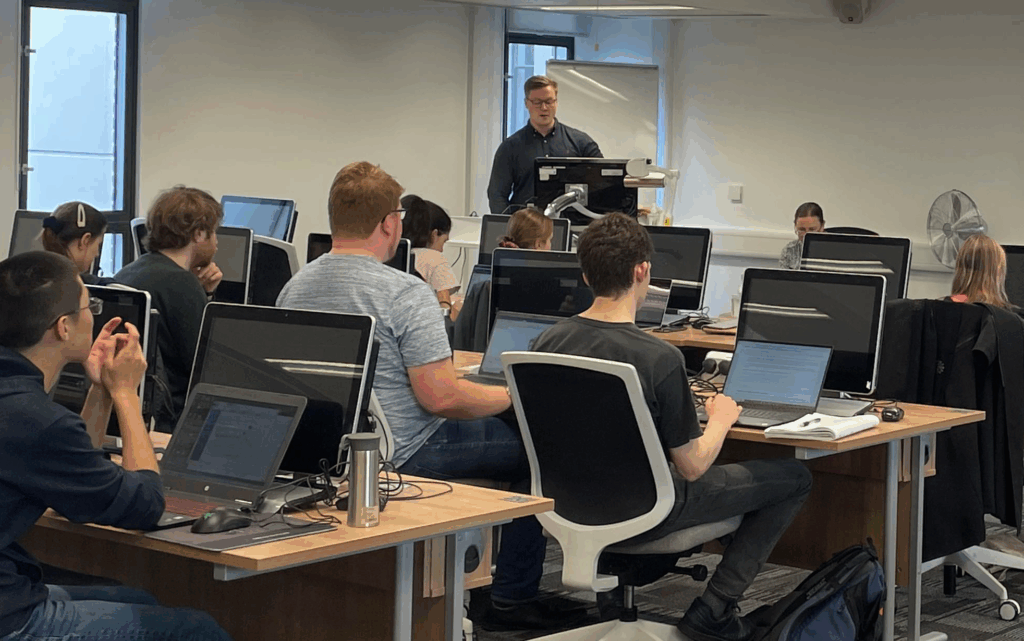
CCPBioSim Training Week, 21st September 2022
The Challenge
An issue that the communities within CoSeC continue to face is that, despite working on cutting-edge software tools, it is often found to be the case that an institution or organisation’s systems are too old to adequately run the latest software. Often installation is blocked, with the system either presuming a security threat or indicating licencing issues. This has led to frequent delays in any attempt to get training established and, in some cases, the very software brought in to help improve training could not be run due to insurmountable IT policies.
The Approach
An issue that the communities within CoSeC continue to face is that, despite working on cutting-edge software tools, it is often found to be the case that an institution or organisation’s systems are too old to adequately run the latest software. Often installation is blocked, with the system either presuming a security threat or indicating licencing issues. This has led to frequent delays in any attempt to get training established and, in some cases, the very software brought in to help improve training could not be run due to insurmountable IT policies.
In 2015, Jupyter Notebook launched, which was aimed primarily at teaching software development. The ability to run various software languages directly in a web browser was a game-changer and with the training also using various languages, such as Python, it was a natural fit for CCPBioSim Training Resources, which uses simulations to further the understanding of the biological functions of proteins. The benefits were instant. Advanced software developers could create their own training environment offline, months ahead of the training workshop, leaving ample time to test and develop different devices. From a user perspective, all the trainee needed was a web browser. When the world went into lockdown during the COVID pandemic, the team at Jupyter began looking for training materials to do their first simulations. With CCPBioSim hosting training courses on Jupyter Notebook, suddenly their attendee numbers jumped from 70 to 700!
“Scientists were stuck at home during lockdown and unable to go into the lab, so they could run our software on their laptops with no technical requirements beyond a web browser. It meant we could deliver fantastic training during an international crisis and teach state-of-the-art viral simulation techniques.” James Gebbie-Rayet, CoSeC Technical Lead for CCPBioSim,
STFC Scientific Computing
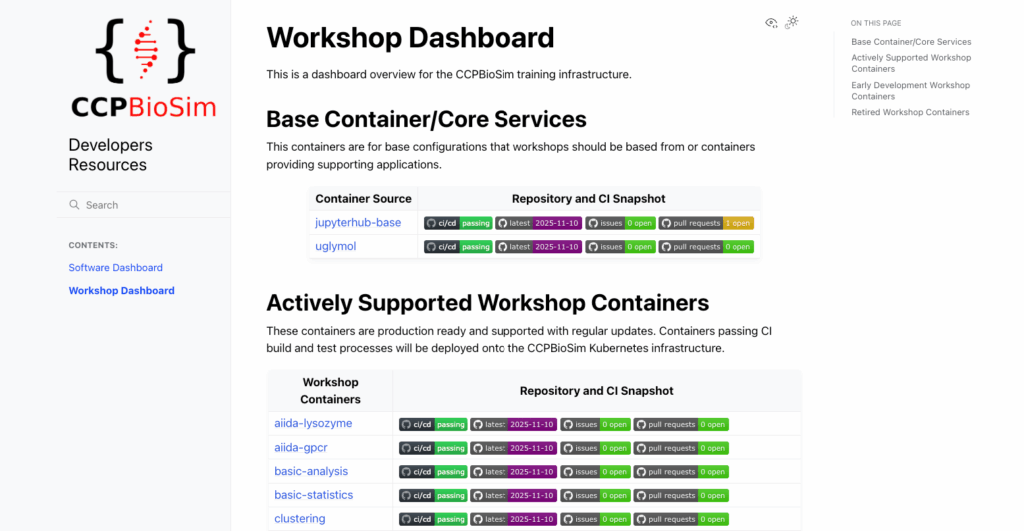
Screenshot of the CCPBioSim Workshop Dashboard
The Benefits
CCPBioSim software engineers now travel to conduct training in countries with developing economies where advanced software programs and supercomputers are unavailable, so far delivering training in South America, Asia and Africa.
Further advantages included the ability to log in and log off without losing progress, and the availability of the team to answer questions on an ongoing basis, as opposed to an in-person workshop with the trainer only there for the day.
With such high demand for training, the challenge now for the team was to not only respond to this demand but also to adhere to its promise to deliver state-of-the-art training. Software packages are being continually updated and the team is constantly updating to the latest version. Over twenty courses are now available with hundreds of different software dependencies. Analytics have revealed a total of 20,000 training sessions delivered remotely since 2020.
Next Steps
The team plans to build a new iteration of the platform and implement a suite that will test each course for viability and simultaneously update to the latest software version. CCPBioSim will have a training resource that is self-testing and self-deploying, automatically updating and ready at one’s fingertips – likely one of the most advanced systems in the world. Already at an advanced stage with five years’ worth of feedback and development, the platform will be hugely beneficial to institutions and organisations to use for their own training programmes. It has been continually tested and developed by people expert in both scientific computing and software development.
“You would never be able to do anything like this without CoSeC. The fact is that we can organise academics across the country to create material for a common purpose – in this case, upskilling. Today scientists are trained more in laboratory conditions, rather than in computing, so they need to be trained in these skills. Every university has to train their own scientists, and we have the capability, expertise and technology to deliver the training and enable them to quickly move forward together.”
James Gebbie-Rayet, CoSeC Technical Lead for CCPBioSim, STFC Scientific Computing