Positron emission tomography (PET) is a functional medical imaging technique which uses radioactive tracers to highlight areas of high activity in the body’s cells. Detectors around the body detect photon pairs and algorithms use this information to determine location of positron emission. It is particularly effective in detecting and diagnosing cancers and is also used in neurology.
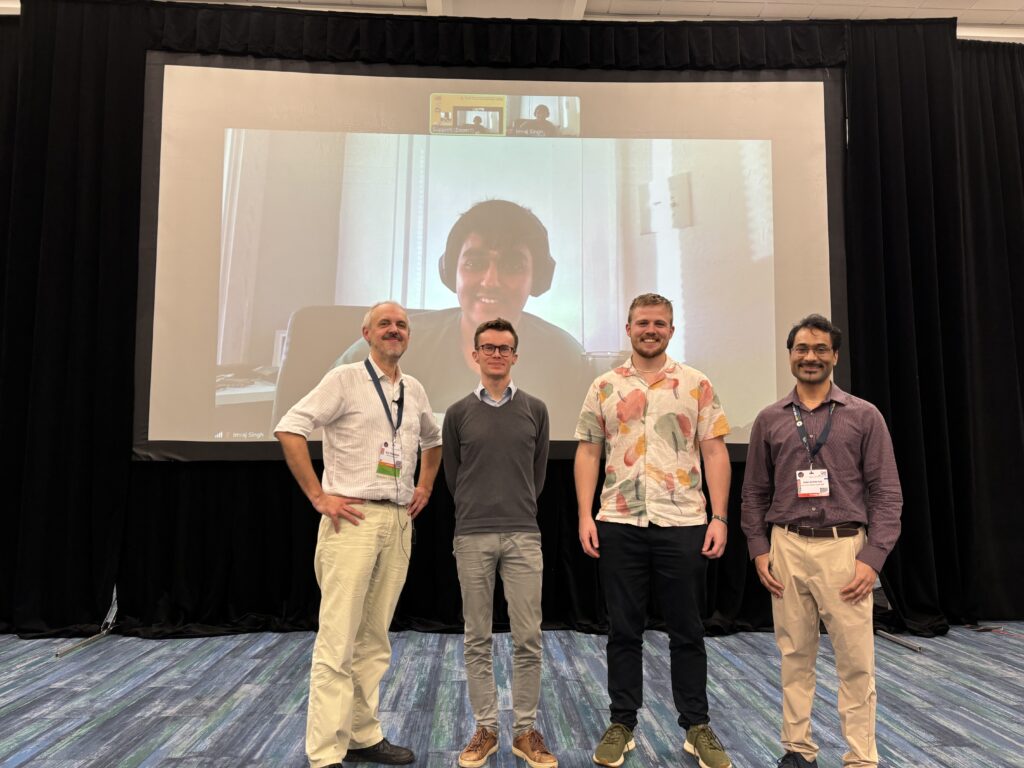
(Left to right), Kris Thielemans (CCPSyneRBI Chair/UCL and organiser), Georg Schramm (KULeuven, winner, team MaGeZ), Sam Porter (UCL, 2nd place, team SOS), Casper da Costa-Luis (STFC, organiser), on the screen Imraj Singh (UCL, 2nd place, team EWS) PETRIC, 2024.
PET images can be blurred, partly due to the small amounts of photons hitting the detector, background radiation, and the difficulty in modelling how the photons travel through the body’s anatomy – for example, to look in the brain you have to get through the skull! Several tomographic image reconstruction algorithms have been developed over the years – analytical, iterative and artificial intelligence (AI) based – all with a focus on improving clinical diagnosis, cancer staging, reducing radiation, and acquisition time. Iterative algorithms can help reduce acquisition time and dose to the patient but require providing some prior information in order to cope with the reduction of data. This is exacerbated by constantly improved scanners and detectors, increasing data sizes with the potential of improved spatial and temporal resolution, but taking longer to reconstruct. Some reconstruction methods have been proposed in literature and that some are currently available with scanners enabling lower acquisition time/low dose.
Over the last two decades, several scientific communities within CoSeC have established the concept of “challenges” to facilitate fair comparison of different algorithms. These are well-known in the fields of image registration, segmentation, and reconstruction. Each challenge focuses on a particular topic to accelerate research in a specific direction. Inspired by these developments, in 2024, CoseC communities CCP-SyneRBI and CCPi held the PET Rapid Image Reconstruction Challenge: PETRIC, and a second has just concluded in April 2026.
The primary aim of PETRIC is to stimulate research and development of faster PET image reconstruction algorithms applicable to real-world data. The challenge used a popular prior which is also used in commercial scanner software but required the participants to develop their own algorithms. The event aimed to develop fast algorithms that would converge in the least amount of time to the same solution of another state-of-the-art algorithm. But the real challenge is to make it happen in minutes rather than hours or days. 10 minutes is what the participants were given as a target: 10 minutes is the amount of time that would be available for reconstruction in a real clinical setting. Participants were given access to a sizeable set of phantom data acquired on a range of clinical scanners. Evaluation occurs on a set of data not available to participants.
A crucial component of the challenge is the use of the Synergistic Image Reconstruction Framework (SIRF) as the common platform for all reconstruction algorithms. All algorithms therefore use the same physical models and function to minimise, and thus their performance is determined purely by algorithmic approach. In addition, CCPi’s Core Imaging Library (CIL) optimisation toolkit was available for algorithm development.
The automated computational framework for the challenge is available as open-source software. Prizes were available to participants who made their solutions open-source.
Four teams with nine algorithms in total participated in the 2024 challenge. Their contributions made use of various tools from optimisation theory including preconditioning, stochastic gradients, and artificial intelligence. While most of the submitted approaches appear very similar in nature, their specific implementation lead to a range of algorithmic performance. As the first challenge for PET image reconstruction, PETRIC’s solid foundations allow researchers to reuse its framework for evaluating new and existing image reconstruction methods on new or existing datasets. Variant versions of the challenge have and will continue to be launched in the future. The three winning teams each gave a presentation on their algorithms and the presentations are available here.
The second PET Rapid Image Reconstruction Challenge (PETRIC2) focused on lower dose data, with a reduction of dose of about 10-fold with respect to PETRIC. This reduction is similar to a reduction of time the patient is in the in the scanner. It ran from mid November-mid February 2026. https://github.com/SyneRBI/PETRIC2/wiki
The three highest-ranked teams were announced during the Symposium on AI & Reconstruction for Biomedical Imaging, which took place in London this March.
The winning team was Margaret Duff from STFC, Georg Schramm from KU Leuven, Matthias Ehrhardt and Hok Shing Wong, both from the University of Bath.
“The PETRIC challenge is transformative for the community, providing accessible and standardised data to test methods and providing a focus for our efforts” explained Margaret. “In both PETRIC and PETRIC-2 the most common algorithms submitted split the data, looking at just a small subset in each step, allowing for small errors but for reduced computational steps. Overall, you might have to take more steps, but each step is less costly. After that, it was interesting to see the differences between the algorithms and how that had an effect on speed. It was also notable that AI methods weren’t submitted for this challenge, suggesting that mathematical algorithms are still very important in areas like PET where there isn’t huge amount of data and the results are safety-critical. Reduced computational cost is so important, both for making algorithms feasible to use in practice, but also for reducing the environmental cost of computation! The challenge is a huge effort from the organisers, especially Edo and Casper in STFC and Kris at UCL, so full credit for the success of the challenge should go to them. ”
The team behind PETRIC includes Casper de Costa-Luis, Evgueni Ovtchinnikov, and Edoardo Pasca from STFC Scientific Computing, and Kris Thielemans and Charalampos Tsoumpas, Groeningen University Hospital. A paper was recently published in Frontiers in Nuclear Medicine, which is available here.