Without information on energy efficiency, developers and users are unable to make informed choices about the way they write or use software. Current understanding is limited, and whilst some communities have started developing guidance on energy efficiency, this is often application specific and time consuming for researchers.
This cross-cutting project aims to generalise existing knowledge of sustainable computing and address common challenges across disciplines. As well as building knowledge, this project will also work to build an underpinning body of knowledge across communities to embed sustainable computing practices.
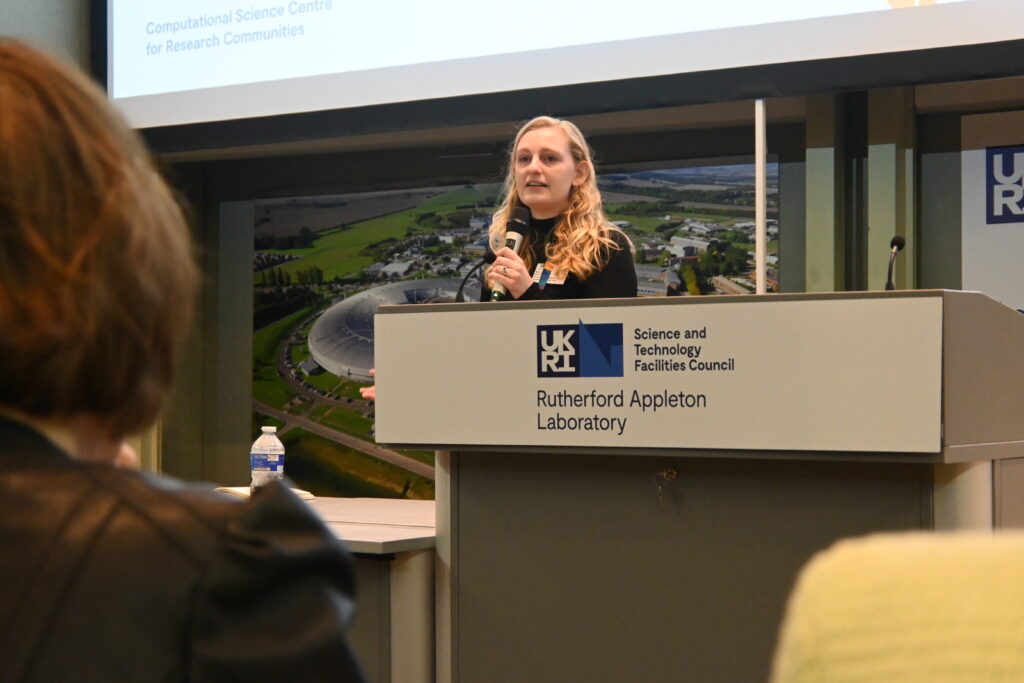
Phase 1 and 2 of this project included a wide-reaching benchmarking exercise and subsequent workshop organised by CoSeC to better understand the current landscape in terms of energy-efficient computing across all communities and start conversations around making energy-efficient choices.
The outcomes of that workshop are now being disseminated as the project moves into phase 3, with further information to be made available later in 2026.
Progress So Far
Phase 1 (January to September 2025)
WP1 Carry out benchmarking of common libraries (e.g. GSL/LAPACK, BLAS) used across CCP software, publicise results, and produce best practice guidance based on our findings: A tool for benchmarking different implementations of BLAS and LAPACK has been created (available at https://github.com/ralna/green-computing-benchmarks). This allows users to experiment with commonly used linear algebra functions, and compare the performance of different libraries that they can then link in their own software. Results were shared through a talk at RSECon 25 (available at https://www.youtube.com/watch?v=olvbS_tWQJ0).
WP2 Work with the CoSeC Programme Office to carry out a detailed survey and liaise with Project Leads to identify their current understanding of good practices of green computing across all CCP communities: A survey to collect information about existing energy efficient computing practices across CCP communities was conducted. This was sent to CCP project leads, and aimed to capture awareness around energy efficient computing principles, challenges and blockers being faced, as well as technical information around use of BLAS/LAPACK. The survey received 14 responses covering 13 CoSeC communities. Results from this survey were used to help develop discussion points for the workshop (WP3) and benchmarks for WP1.
WP3 Organise a wide-reaching workshop to better understand the current landscape in terms of energy-efficient computing across all CCPs and start conversations around making energy-efficient choices: A workshop was held on 15-16th September 2025 at RAL, and was attended by over 50 people (with a mix of in-person and online attendees). The workshop sessions revolved around four key themes: Qualitative Algorithms, Community, Hardware, and Quantitative Practice with talks from 10 speakers, as well as time for breakout discussions. A summary of the event can be found here: https://www.cosec.ac.uk/impact/a-multi-disciplinary-approach-to-embedding-energy-efficient-computing-practices-outcomes-from-our-energy-efficient-computing-workshop/ . One output of the workshop was a commitment to produce a white paper based on topics discussed, outlined below in WP5.
Published papers:
- Communication Lower Bounds and Optimal Algorithms forSymmetric Matrix Computations (H. Al Daas, G. Ballard, L. Grigori, S. Kumar, K. Rouse, M. Verite)
- Brief Announcement: Minimizing Communication for Parallel Symmetric Tensor Times Same Vector Computation (H. Al Daas, G. Ballard, L. Grigori, S. Kumar, K. Rouse, M. Verite)
Phase 2 (October 2025 to March 2026)
WP4 Following on from WP1 (benchmarking of common linear algebra libraries), we will continue to develop our benchmarking framework, making the tool available for users (through platforms such as SHAREing and CAKE) to determine the most energy efficient BLAS/LAPACK implementation to use for their problems. This will involve writing a user interface and clear documentation, as well as reaching out to CCPs for feedback from potential users: Development on the benchmarking tool has continued, and the ability for users to configure the functions and problem sizes they want to benchmark with a configuration file has been added. Documentation has also been updated to reflect this, and to provide clearer instructions on installing and running the tool. Support has also been added for running on Nvidia GPUs with CuBLAS, and work has been started on supporting AMD’s HIPBLAS.
WP5 Following WP3 (Energy Efficient Computing workshop), we will write and publish a white paper outlining the current green computing best practice discussed at the workshop and highlighting key priorities to address going forward: Progress has been made on writing a white paper, with contributions from many of the workshop speakers. So far a draft has been produced, with some speakers requiring extra time to make their contributions. Once all contributions have been finalised, we will look to publish the report on arXiv and seek a suitable journal for publication.
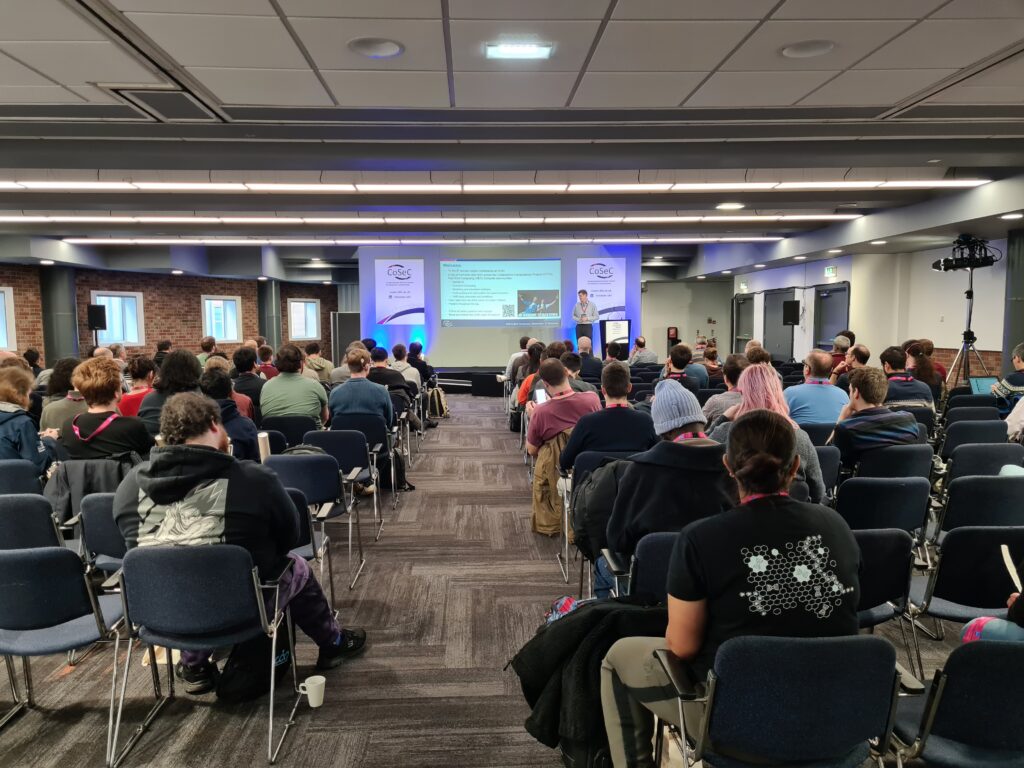
WP6 Disseminate project findings at conferences and events, including a talk and posters at the CoSeC Annual Conference in December 2025, the Sustainability Conference for Responsible Research Computing (https://indico.cern.ch/event/1526482/), and WCCM-ECCOMAS 2026 (https://wccm-eccomas2026.org/): This project has been presented at RSECon25 and the CoSeC Annual Conference 2025. An abstract has also been accepted for a presentation at the upcoming WCCM-ECCOMAS in July 2026.
Published papers:
- Communication Lower Bounds and Algorithms for Sketching with Random Dense Matrices (H. Al Daas, G. Ballard, L. Grigori, M. T. Hussain, S. Kumar, M. M. Rahman, K. Rouse)
- Another paper is submitted to Supercomputing26 (currently under double blind peer review)