Research outputs, such as software codes, projects, test cases, publications, data and events are often either not shared at all, or all shared in different places without any links in place to connect them. For example, software codes might be shared via GitHub, data via universities’ institutional repositories or Zenodo, events via individual projects website, publications via universities’ institutional repositories etc. The potential impact of cataloguing these research outputs in one place, such that they are FAIR (Findable, Accessible, Interoperable and Reusable) is high. The result of the application of FAIR attributes is well known and something all data, whether that data is experimental, simulated, or in the form of research outputs, should aim to adhere to.
Following on from the development of CAT-WSI, and a catalogue for CCP-NTH, a high-level CoSeC Catalogue is now being developed. It will provide a central location for all the individual CCP catalogues but additionally, a cross-search over the various domains.
The CoSeC Catalogue, therefore, can be thought of as a collection of domain-specific catalogues together with an integrated search across them all. The main intention of the CoSeC Catalogue is to highlight research outputs, however the potential impact goes further, for example the application of FAIR principles, encouraging collaboration, and making the impact of CoSeC more identifiable and quantifiable.
Progress So Far
Pilot Project (November 2024 to March 2025)
The CoSeC Catalogue Pilot Project investigated the feasibility of developing a CoSeC Catalogue. There is no intention of mandating that CCP communities have their own domain specific catalogue as part of a wider CoSeC Catalogue and as such understanding the views of the communities on this subject, before any decision is made, is pivotal. We found that nearly all of the CCPs we spoke to during this pilot project were either positive, or very positive, both about having a research output catalogue specific to their domain, and it being included in a wider CoSeC Catalogue. There were some concerns, but also suggestions as to how to mitigate against them. The overarching goal was to provide a fair and accurate assessment of the likely success of a CoSeC Catalogue.
In total we met with 12 of the CCPs and discussed in detail whether they see the value in a CoSeC Catalogue and would be willing to be part of it, if successful. Of these discussions, 9 of the CCPs were positive, or very positive, about the catalogue. Some liked the potential for their communities to find and re-use relevant resources, others preferred the impact of such a catalogue and the resulting, potential reduction in reporting statistics to CoSeC as these could be automatically generated from the catalogue. All recognised that the CoSeC Catalogue provides a practical solution to making research outputs FAIR and the importance of this.
Some concerns were noted, mostly around the effort that the individual CCP would need to contribute to the catalogue, both initially and ongoing. We have investigated potentialmitigations to these concerns which include automation of adding records to the catalogue where possible, through use of APIs with other data holders eg GitHub, Research Fish and Web of Knowledge. This reduces the effort required by the CCP to review and addition of any relevant domain specific metadata. For CoSeC Project Office supported training events, we would also propose that the support the CCP receive in the administrative tasks required to run the event include the initial addition of the training event to the CoSeC Catalogue. The member of the admin team would need to work with a representative of the CCP to obtain accurate domain specific metadata for it as well.
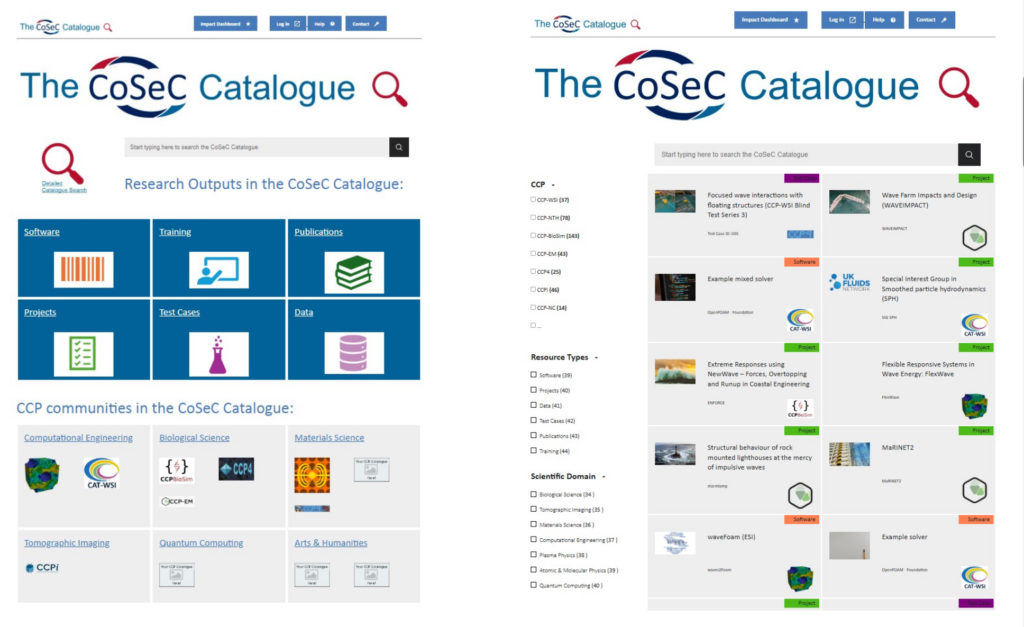
As a result of the conclusions documented above, mock ups were produced as an illustration of what a CoSeC Catalogue could look like.
Phase 1 (June 2025 to March 2026)
Due to the success of the CoSeC Catalogue Pilot Project, as outlined above, it was agreed that work would develop the catalogue and Phase 1 of the project ran from June 2025 – March 2026 and had four main areas of work:
Requirements (June 2025 to September 2025): Requirements gathered and documented, building on work done around this in the Pilot Project. This included both requirements on individual sub-catalogues from the CCPs themselves, in addition to what is required for impact reporting by the CoSeC Programme Office.
Data Curation (June 2025 to March 2026): The metadata schema for the CoSeC Catalogue is very complex. In addition to having common metadata fields across all resource types and CCPs, each resource type within each CCP will have some custom metadata relevant only to that specific resource type in their specific field. Common metadata fields need to be proposed and agreed, and also discussions need to be had with each participating CCP to guide them in the specification of the relevant custom metadata. An experienced data steward is required for this work as the effectiveness of the catalogue’s search functionality, and hence the success of the catalogue overall, is highly dependent on accurate and appropriate metadata schemas. This work package defined the common metadata fields and custom metadata fields for the first participating CCPs of the CoSeC Catalogue.
Prototyping (June 2025 to September 2025): The pilot project identified that the proposed technological solution was unfortunately not appropriate for the CoSeC Catalogue. As a result, two further technological solutions were proposed: one using Elastic Search to store data with a bespoke frontend, and one based on semantic web technology. This work package consisted of a feasibility study of using sematic web technology to develop the CoSeC Catalogue and an objective comparison of the elastic search approach. At its conclusion, a decision was made by the whole development team, with Elizabeth Newbold as chair, as to which approach to take for development.
Development (October 2025 to March 2026): This work package will develop an MVP of the CoSeC Catalogue in the technology as concluded by the prototyping work package. The MVP will include at least three CCPs with at least two resource types in common. Likely candidates for the three initial CCPs are CCP-WSI, CCP-NTH and CCPBioSim. The three resource types present in the CCP-WSI prototype will be included for them here specifically (Software, Test Cases and Projects). Resource types included in the MVP for CCP-NTH and CCPBioSim are still to be confirmed but will include at least two resource types in common. Final specification of which CCPs and which resource types will be included in the MVP will be part of the Requirements and Data Curation work packages.
Phase 2 (April 2026)
Phase 2 is now under development.