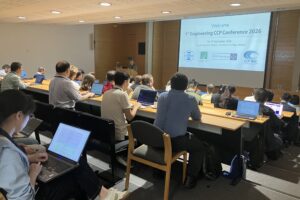
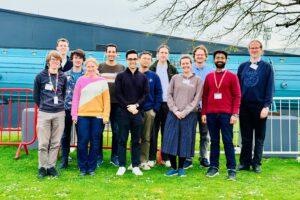
On 5th June, CCP-QC led a Quantum Algorithms Day following the CoSeC Communnity Forum the previous day.
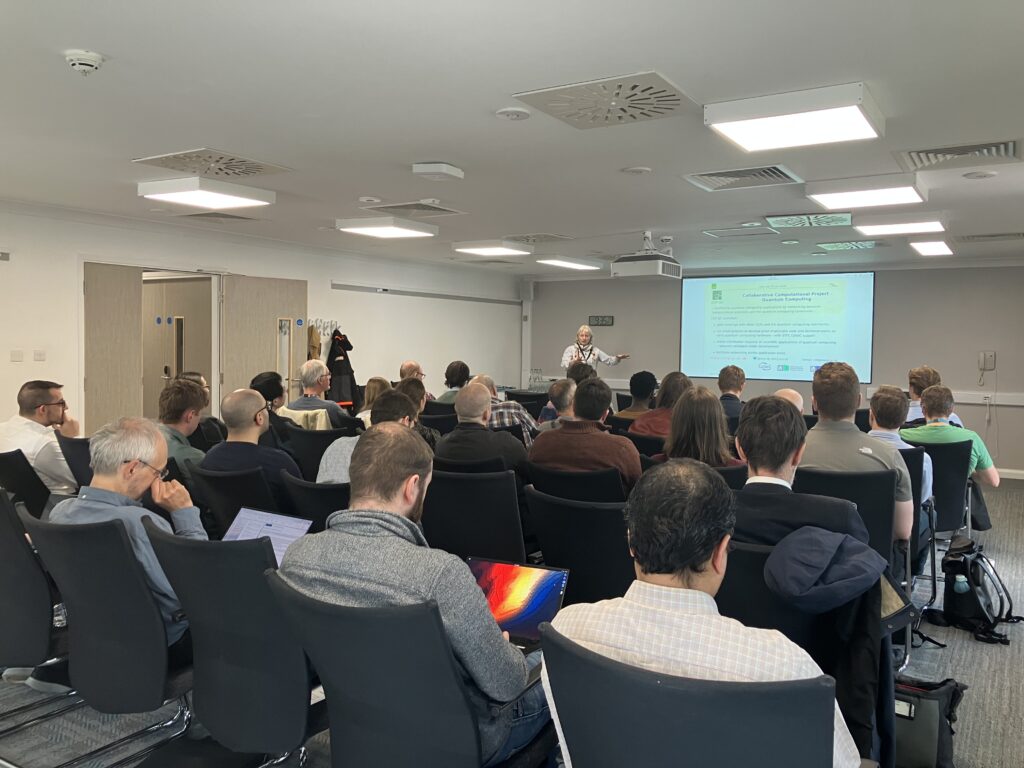
CCP-QC Chair Professor Viv Kendon welcomed around 50 attendees and speakers, and gave a general introduction to CCP-QC, the team, and their collaborations. She discussed the CCP-QC Bridging project, funded in 2024, which is enabling research on quantum algorithms for electronic structure calculations, fluid simulation algorithms, and linear equation solvers. A catalogue of quantum computing resources is also under development.
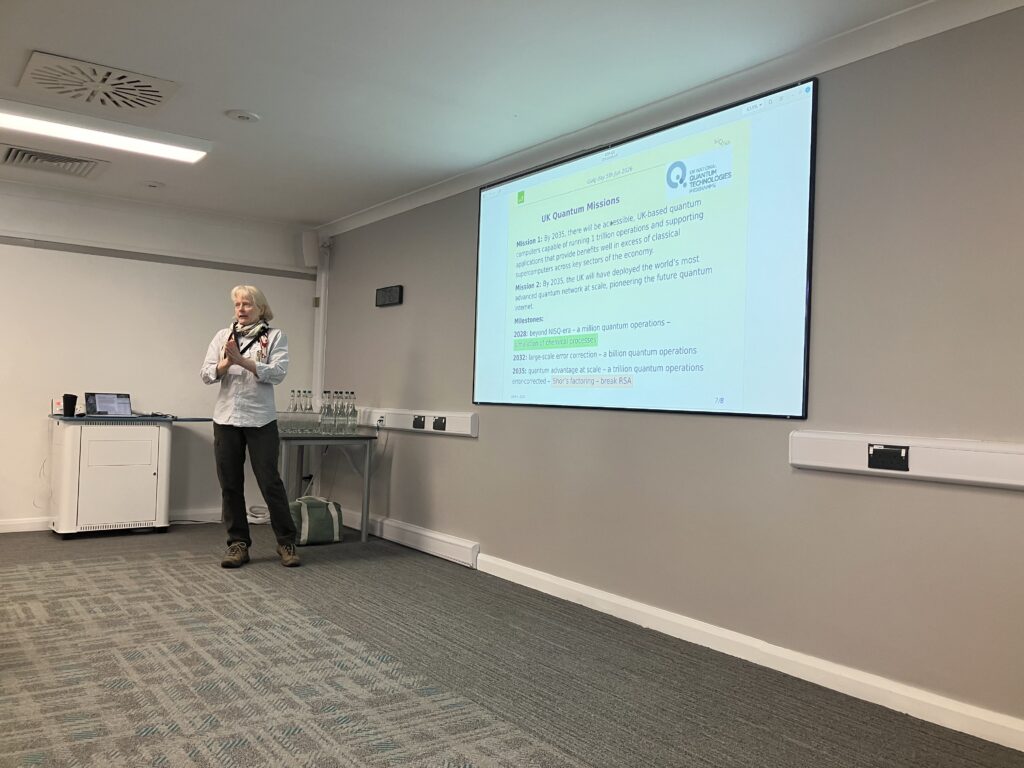
Viv then introduced the UK’s Quantum Missions –
- Mission 1 – By 2035, there will be accessible, UK-based quantum computers capable of running 1 trillion operations and supporting applications that provide benefits well in excess of classical supercomputers across key sectors of the economy.
- Mission 2 – By 2035, the UK will have deployed the world’s most advanced quantum network at scale, pioneering the future quantum internet.
The milestones to be reached are:
2028 – a million quantum operations
2032 – a billion quantum operations
2035 – a trillion quantum operations
John Fitzgerald, Senior Portfolio Manager, EPSRC Quantum Technologies Team – UKRI support of the quantum research landscape
John discussed the support and funding opportunities available in coming months. He highlighted changes to the EPSRC New Investigator Awards and to UKRI’s Individual Eligibility policy, as to whom can apply, to ensure a more unified and open approach to both. He also noted upcoming calls for quantum software and applications due to be opened soon.
Oliver Brown, EPCC – HPC Integration
Evaluating properties in quantum computing is difficult and methods need to be devised to extract information, which team members have been able to do with heat transfer and combinatorial optimisation. Networking of quantum computers is necessary to organise a faster transfer of information. Programming accelerators is hard and quantum computing can even make them worse. The answer is to start early. Oliver said that a good programming model should suffice as it is then flexible enough to support novel applications. It is constrained enough to enable programmers to make good decisions and simple enough to enable novice programmers.
Fortran is the most highly used software, as well as C/C++ and Python but there is not yet a good high-level way to describe quantum algorithms. Tightly coupled accelerator quantum processing units (OPUS) are clearly a long way off but loosely coupled HPC-QC is available from IBM/Hartree and the National Quantum Computing Centre (NQCC).
Steph Foulds, University of Strathclyde – Quantum algorithms for fluid simulation
Steph introduced quantum walks, where there is speedup for search and routes. She discussed scalable quantum computing with neural atom quantum processors as an example, which have identical high-quality qubits and dynamically reconfigurable qubit arrays.
Quantum walks are suited to the Quantum Lattice Boltzmann method as they map exactly and introduced encoded quantum walks on an N-node ring. The native 4-qubit gate is highly beneficial. Steph is also working on various projects with Kathryn Lund at STFC on end-to-end classical-quantum sources of error, as well as state preparation reversal for readout, which was discussed at the CoSeC Community forum.
Yannic Rath, National Physical Laboratory – Quantum Software and Modelling at the National Physical Laboratory
The National Physical Laboratory’s current prime focuses in quantum computing are standardisation and measurement, developing quantum technologies (e.g. atomic clocks and beyond), materials science and chemistry. When benchmarking the capabilities of current quantum computing hardware, two perspectives need to be considered – the hardware perspective and the end-user perspective.
Community driven standardisation of benchmarks and metrics are needed to objectively quantify and guide progress towards quantum advantage. Work commissioned by the NQCC has concentrated on open standards for emerging quantum processors, providing a useful taxonomy of benchmarking workflows.
To benchmark practical quantum advantage, Yannic said that the actual algorithms also need to be considered. The end-user benchmark can be achieved by probing quantum advantage by co-designing classical and quantum algorithms, and for the hardware benchmark, using QCMet, a holistic set of metrics to benchmark quantum computers.
James Thorne, National Quantum Computing Centre (NQCC) – HPC and SparQ Access at NQCC
NQCC’s mission is to provide first-class research, secure quantum computing. The Centre has a HPC cluster called QUASAR which is physically close to the QPUs, with a focus on network security best practices. NQCC has been working with Hartree on a QRMI plugin.
NQCC has seven commercial quantum computers and has computing infrastructure for QC access, with a hackathon being held this August. They are driving user adoption and economic value through their SparQ quantum readiness engagement programme –SparQ programme – NQCC/.
John Buckeridge, LSBU on behalf of Bruce Camino, UCL – Quantum algorithms for materials simulation
Materials modelling at the atomic scale is dominated at present by the application of density functional theory (DFT). DFT balances accuracy and computational tractability but requires some experimental knowledge to parameterise calculations.
The current challenge is solid solutions and what happens when two materials are mixed together. We need to find a range of energetically favourable configurations in alloy/solid solution which is a major combinatorial problem. There are many complications, but it is a particularly important problem.
There also exists continuous time quantum computers that encode via qubits in an analogue way using adiabatic theorem. The problem they want to solve is using quantum annealing to perform the configurational analysis of disordered materials and find thermally accessible configurations and compute thermally averaged properties.
James Ingoldby – Quantum Simulation of False-Vacuum Decay
A QFT starts in a false vacuum where bubbles nucleate. A quantum device stores the state as a quantum state. James asked the question why use a quantum computer, comparing classical and quantum simulation. From this comparison, the strategy going forward is to use classical simulations as a trusted benchmark, then test whether quantum hardware can follow the dynamics further in time.
False-vacuum decay gives a physically meaningful real-time benchmark. The O’Brien-Fendley model, which James demonstrated, provides a qubit-native spin-chain testbed with a continuum field-theory limit. TVDO-MPS gives controlled classical benchmarks for the decay dynamics and error-mitigated hardware data shows the first signs of the expected dynamics. In conclusion, false-vacuum decay is not a random circuit benchmark but a scalable physics problem that tests quantum hardware in a real-time QFT setting.
Peter Brearley, Manchester University – High-order splitting methods for non-unitary dynamics
All linear dynamics can be decomposed into unitary and non-unitary components. Peter is working on the application for damped waves, using quantum circuits for operator splitting.
Operator splitting means operators can continuously be decomposed until simulatable. All positive real dissipative steps mean we retain optimal success when each stage can be implemented exactly.
Matthew Christensen, University of Warwick – Quantum Algorithms for Plasma and Fusion Physics
Plasma physics is key in applications for fusion reactors and solar physics. Plasma is modelled with the particles probability distribution function, evolved via the Vlasov-Poisson system.
The problem is that quantum mechanics is inherently linear. The solution is to create a linear system of Ordinary Differential Equations (ODEs) to approximate the original nonlinear dynamics. They used Carleman embedding to create the approximate linear system. Once linearised, the process can be solved using standard quantum linear differential equation solvers.
Kinetic plasma physics is a computationally hard nonlinear problem. Direct application of Carleman embedding to Vlasov-Poisson system requires non-physical collision frequencies. Shifting the problem to the equilibrium allows some physical systems to be modelled using Carleman embedding.
Thomas Howarth, Loughborough University – Fourier extensions for block encoding matrix functions
Block encoding is a practical means of non-unitary quantum computation – how do we trade off and make the error tolerance lower? Linear Combination of Unitaries (LCU) is the most popular framework for block encoding and can be used to block encode functions of matrices.
Analytic Fourier series of triangular continuation gives polynomial error, with optimal subnormalisation. Fourier extensions can be used to obtain exponentially converging LCU. Fourier extension basis is redundant (which is typically seen as bad), but Thomas pointed out that this can be exploited to minimise subnormalisation via Sobolev regularisation.
General functions of non-unitary matrices (e.g. action, exponentiation) can be accurately and easily block encoded and matrix inversion is an efficient linear system solver.
Karl Michael Ziems, University of Southampton – Molecular property simulations on quantum computer
Developing new algorithms for simulating chemistry on quantum computers involves molecular properties, optimisation, early fault-tolerant QKS and embedding. Error mitigation is a fact of everyday life when using a quantum computer. Karl Michael examined the spectroscopic properties on a quantum computer, considering how to simulate light-matter interaction in molecules and access spectroscopic properties.
Ryan LaRose, Michigan State University – ATP Hydrolysis on a Quantum Computer
ATP hydrolysis is the most important biochemical reaction in biology. The grand challenge is being able to model dynamics, not just statics, across scales with extreme accuracy. This is where quantum algorithm scaling can help, generating Hamiltonians and ADAPT circuits, using circuit simulators and optimising circuits.
Their co-designed variant of ADAPT-VQE incorporates information related to hardware costs into the selection criterion, providing a general framework for co-designed state preparation circuits. They combine this with techniques to decrease gate counts for fermionic systems, such as fermionic swap routing and a dynamic mode-to-qubit assignment. This results in a reduction of up to 97% in the CX/CZ count of the final circuits. More ADAPT iterations result in better algorithmic accuracy, but more hardware noise.
Shruti Jain, Northeastern University, London – Portfolio Optimisation with Markov chain Monte Carlo
Shruti discussed Portfolio Optimisation with several approaches including Visual Question Answering and Conditional Value at Risk. She and her team are working on an algorithm outline with Markov Chain Monte Carlo (MCMC), proposing a parameters update, using gradient information and compared the convergence plot with MCMC optimisers, then standard optimisers.
Sofia Moliner, Imperial College London – Quantum Fast Forwarding for heat PDEs with time-dependent BCs
Sofia discussed the Black-Scholes partial differential equation (PDE) for pricing European options and the challenges of the Quantum Fast Forwarding (QFF) algorithm in option pricing. Their main result was solving a time dependent heat PDE via a linear combination of QFF solutions. This offers complexity analysis and condition for quantum advantage, together with solving the Black-Scholes PDE for option pricing.
Joseph C.R. Thacker, SC – Hybrid HPC and Quantum
Joseph works in quantum mechanics/molecular mechanics (QM/MM) which allows quick scaling. He is focusing on developing hybrid QC/HPC workflow within ChemShell, their Python-based open-source software and implement a multilayer subtractive embedding scheme for hybrid HPC/quantum computing.
The aim is to embed active space embedding and provide a scalable solution for realistic chemical systems, suitable for use with emulators and quantum hardware as it is developed.
Hoping to run on a quantum computer but unable to, Joseph worked on parallelism, with a distributing memory parallelism running over shots and finite difference geometries.
Future work involves generalising beyond quantum phase estimation to support other quantum algorithms and examining additional quantum observables such as analytical forces and electron-density.
Flash Talk abstracts
For further details, all flash talk abstracts are available here.
Discussion and collaboration opportunities
Each speaker then spoke about hopes for the future in the development of quantum computing and potential collaboration opportunities.
Viv thanked all the speakers and attendees for joining a fantastic day of collaboration.