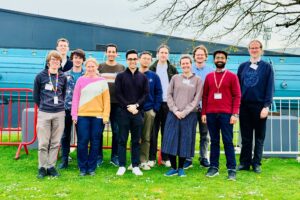
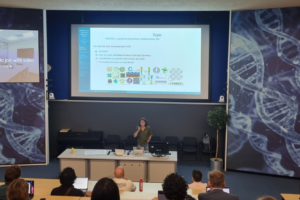
In June 2026, I attended the CoSeC Community Forum at the University of Warwick, where I delivered an invited lecture as part of the presentation of the 2025 CoSeC Impact Award. My lecture, titled “OpenSBLI: Automatic code-generation and DSLs for high-fidelity aerospace simulations on GPUs,” described the computational fluid dynamics research undertaken over the past decade with support from CoSeC through CCP Turbulence and the UK Turbulence Consortium.
Receiving the award was a great honour and provided an opportunity to reflect on the development of OpenSBLI, the research it has enabled, and the support that OpenSBLI and I have received from CoSeC. My involvement with UKTC and CCP Turbulence began during my PhD in the Aerodynamics and Flight Mechanics group at the University of Southampton, under the supervision of Professor Neil D. Sandham. During this period, we developed OpenSBLI, a CFD solver designed to perform high-fidelity simulations of high-speed fluid flows on modern computational architectures, including GPUs.
Unlike a conventional CFD solver with a static source-code base, OpenSBLI [1,2] uses the symbolic algebra library SymPy to generate simulation code automatically in Python. Users provide a mathematical description of the physical problem and select the required numerical and modelling options. OpenSBLI then generates a complete C/C++ simulation code tailored to that problem. The generated code uses the Oxford Parallel Structured (OPS) domain-specific language library (https://op-dsl.github.io/). OPS can generate parallel implementations using programming models including CUDA, HIP, SYCL, OpenMP, and MPI, allowing OpenSBLI simulations to run across a range of high-performance computing systems from a single source-code base.
OpenSBLI has now been applied to many high-fidelity fluid-flow problems and is used internationally at universities and national aerospace laboratories, including JAXA and NASA. Applications have included compressible turbulence, transition, shock-wave/boundary-layer interactions, and transonic airfoil buffet [3,4]. The CoSeC Impact Award recognised both these scientific applications and the wider contribution that open-source CFD software development can make to collaborative international research.
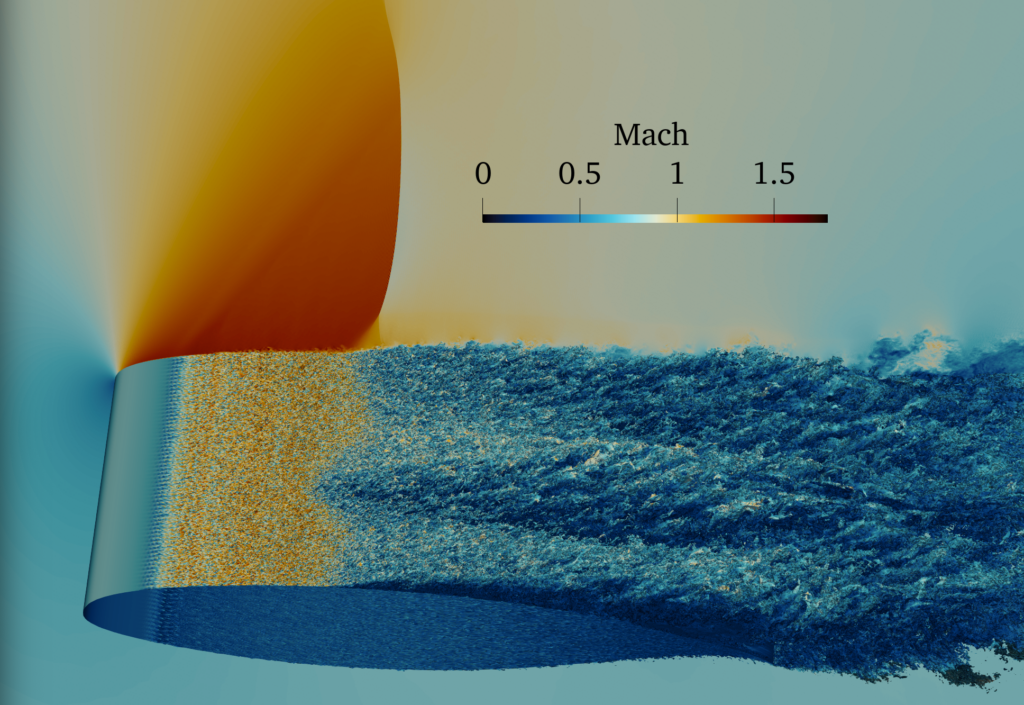
A high-fidelity simulation of turbulent transonic airfoil buffet using the OpenSBLI CFD solver on GPUs
Support from CoSeC and CCP Turbulence enabled us to organise multi-day OpenSBLI and OPS training workshops in Abingdon in 2023 and 2025. These workshops combined introductory material with practical coding sessions for researchers from universities across the UK who were interested in applying domain-specific languages to their own projects. The workshops also gave me an excellent opportunity to meet new OpenSBLI users, understand the computational problems they were studying, and provide direct support for their research. These interactions have helped us extend the capabilities of OpenSBLI and broaden the range of problems to which it can be applied. This form of community engagement is particularly valuable for ensuring that research software continues to develop in response to genuine scientific requirements.
Compared with specialist workshops focused on fluid mechanics, the CoSeC Community Forum allowed me to present OpenSBLI to researchers from a much broader range of physical-science disciplines. The discussions gave me a greater appreciation of the computational challenges encountered in other fields and, importantly, how much those challenges have in common with those faced by the CFD community. Software maintenance, long-term sustainability, porting applications to GPUs and other emerging architectures, artificial intelligence, and the use of reduced or mixed floating-point precision were recurring themes across multiple research domains. One of CoSeC’s strengths is its ability to bring these communities together so that computational advances developed in one field can be discussed, adapted, and applied elsewhere. This exchange of ideas helps researchers avoid independently recreating and testing techniques that have already been demonstrated successfully in other disciplines.
I was very pleased to attend the forum, accept the award, and discuss OpenSBLI and scientific computing with its participants. The questions and feedback following my lecture gave me several new perspectives that will be valuable in my future research and software-development activities.
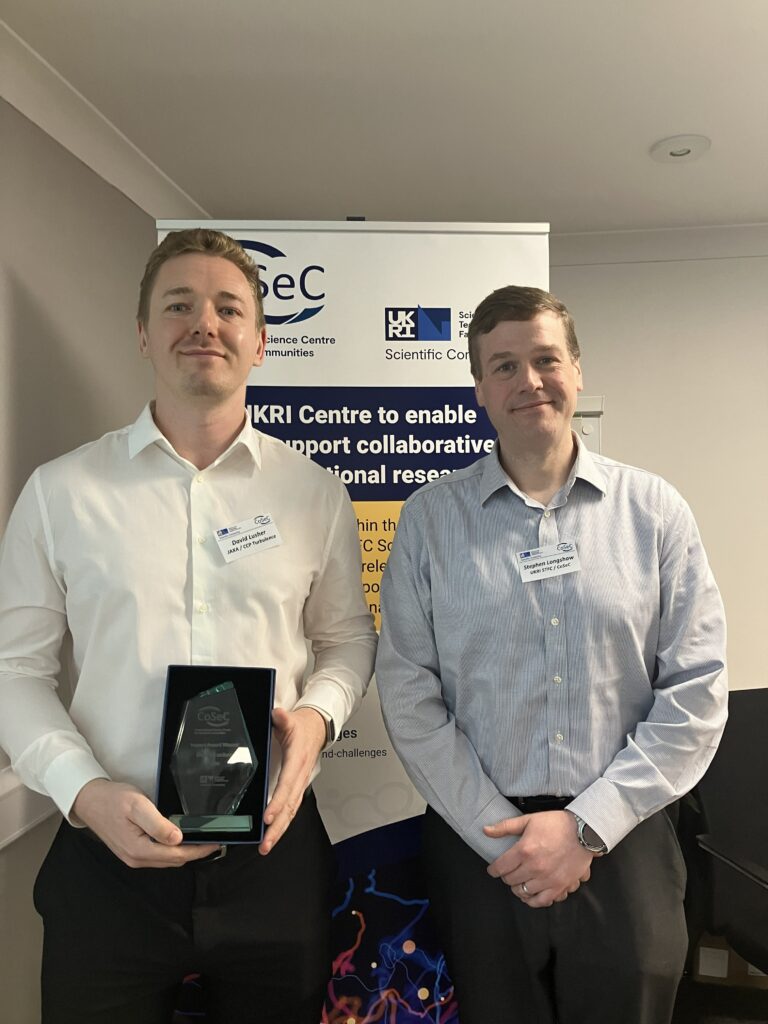
Receiving the 2025 CoSeC Impact Award at the CoSeC Community Forum
The forum also included extensive discussion of the organisation of UK research communities, access to high-performance computing resources, and the procurement of future national machines. These sessions gave me a better understanding of the routes to HPC access being considered in the UK and allowed me to compare them with my experiences in other countries. The subsequent days focused more on technical themes, including energy-efficient computing, FAIR data, artificial intelligence, and quantum computing. I was particularly interested in learning about the algorithms and hardware being developed for quantum computing, as well as the longer-term prospects for applying these technologies to simulation-based research in the physical sciences.
Directly after the CoSeC Community Forum, I travelled to San Diego to attend the American Institute of Aeronautics and Astronautics (AIAA) AVIATION Forum with travel support from CoSeC. At the conference, I presented research performed using OpenSBLI on GPUs to assess the accuracy of reduced- and mixed-precision calculations for CFD simulations [5]. The study used a new benchmark problem involving turbulent shear layers and vortices [6,7], developed to support turbulence-model research through a collaboration between JAXA and NASA Langley. OpenSBLI was used to produce the open-source direct numerical simulation reference datasets, which are available through the JAXA DNS database (https://jaxa-dns-database.jaxa.jp/vortex.html). The benchmark represents a simplified, geometry-free model of a turbulent wing-tip-vortex and was designed to support the assessment and development of Reynolds-averaged Navier–Stokes turbulence models used widely in both industry and academia for aerospace applications. The mixed-precision research builds on recent developments in this area within the OpenSBLI and OPS libraries and demonstrates another advantage of an automatic code-generation framework: new numerical and computational approaches can be introduced systematically across generated applications and evaluated on modern hardware [8] from a high-level problem specification.
Overall, I enjoyed the opportunity to attend the CoSeC Community Forum, exchange ideas with researchers from across the physical sciences, and present further OpenSBLI research at a major international conference. Receiving the CoSeC Impact Award further highlighted the importance of sustained investment in open-source research software, training, and collaboration. I am very grateful to CoSeC, CCP Turbulence, UKTC, and all the colleagues and collaborators who have contributed to OpenSBLI’s development and applications over the years.
References:
[1] D.J. Lusher, S.P. Jammy, N.D. Sandham. OpenSBLI: Automated code-generation for heterogeneous computing architectures applied to compressible fluid dynamics on structured grids. Computer Physics Communications, 267, 108063 (2021).
[2] D.J. Lusher, A. Sansica, N.D. Sandham, J. Meng, B. Siklósi, A. Hashimoto. OpenSBLI v3.0: High-fidelity multi-block transonic aerofoil CFD simulations using domain specific languages on GPUs. Computer Physics Communications 307, 109406 (2025).
[3] D.J. Lusher, A. Sansica, A. Hashimoto. Implicit large eddy simulations of three-dimensional turbulent transonic buffet on wide-span infinite wings. Journal of Fluid Mechanics 1007, A26 (2025).
[4] D.J. Lusher, A. Sansica. Scale-resolving simulations and data-driven modal analysis of turbulent transonic buffet cells on swept infinite wings. Physical Review Fluids 11 (5), 053401 (2026).
[5] D.J. Lusher, A. Sansica. Accuracy of Mixed-Precision Stencil Computations in GPU-Accelerated DNS of Turbulent Shear Layers and Vortices. AIAA AVIATION Forum, AIAA 2026-4395 (2026).
[6] D.J. Lusher, A. Sansica, G.N. Coleman, P.R. Spalart. Study of a System of Turbulent Shear Layers and Vortices. Part I: Direct Numerical Simulation and Theoretical Considerations. Theoretical and Computational Fluid Dynamics 40(4), 21 (2026).
[7] A. Sansica, D.J. Lusher, L. Wang, G.N. Coleman, P.R. Spalart. Study of a System of Turbulent Shear Layers and Vortices. Part II: Reynolds-Averaged Turbulence Modelling. Theoretical and Computational Fluid Dynamics 40(4), 24 (2026).
[8] B. Siklósi, P.K. Sharma, D.J. Lusher, I.Z. Reguly, N.D. Sandham. Reduced and mixed precision turbulent flow simulations using explicit finite difference schemes. Future Generation Computer Systems, 175, 108111 (2026).