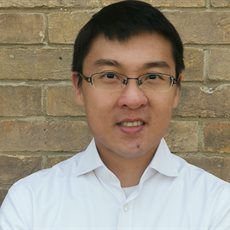
BIO
Zhong-Nan Wang graduated with the BEng degree (1st) from Xi’an Jiaotong University, which is in the C9 league and located in Xi’an that has been the capitals of 13 dynasties in the Chinese history. He was selected into a PhD program in Tsinghua University with joint study at the Whittle Laboratory in Cambridge under the framework of Low Carbon Energy University Alliances (Tsinghua, Cambridge and MIT). His PhD thesis is on developing low-dissipation and high-resolution numerical methods that enable turbulent eddy-resolving simulation with complex geometries for turbomachinery flows. The developed methods were later incorporated in the Rolls-Royce in-house CFD solver to improve the turbulence eddy resolving capability.
After obtaining the PhD degree in 2014, Zhong-Nan spent a short spell in industry and then returned to Cambridge as a research associate at the Department of Engineering in 2015. In the meantime, he was a postdoctoral research fellow in Trinity Hall (2015-2019) and Lucy Cavendish College (2019-2020). He gradually directed his research into computational aeroacoustics, particularly on developing high-fidelity eddy-resolving methods to tackle the problem of noise generated by turbulence. He collaborated nationally and internationally on this research direction via participating in two EU projects on installed jet noise and fan broadband noise, and being a visiting research fellow on studying fundamental noise source dynamics and optimisation for jet noise reduction in a CTR summer program at Stanford University. He was awarded “the best use of ARCHER” to recognise the outstanding work achieved using the UK national scientific computing service ARCHER (currently ARCHER2) and selected into the faces of HPC as a celebration of diversity in HPC community. He was also actively engaged in disseminating his research to general public and won several scientific photo competitions with his research-generated figures, including ARCHER Image Competition 2018 and Cambridge Engineering Photography Competition 2020.
Since joining the University of Birmingham, Zhong-Nan is actively involved in developing the Birmingham Aerospace Engineering Programme. He also built a Computational Aerodynamics and Aeroacoustics (CA2) group, developing high-fidelity CFD and data-driven methods to address the issue of noise and loss generated by unsteady turbulent flows.
PROPOSAL
According to WHO, environmental noise is the second-largest cause of health issues, just after air pollution, in Europe. Turbulence-generated noise is a major source of environmental noise. Accurate prediction of it is critically important for low-noise design. The advances of high-fidelity simulation and high-performance computing enable us to resolve major noise-producing processes in turbulence and their noise radiation from first principles. However, accurate prediction of turbulence-generated noise at high frequencies remains a major computational challenge within the fluid dynamics community. High-frequency noise, which are highly sensitive to, originates from small-scale turbulent structures. Large-Eddy Simulation (LES) provides an effective framework for resolving energy-containing turbulence dynamics at relatively low frequencies ( St=fD/U<2)), but capturing the full range of turbulence scales that are responsible for high-frequency acoustic radiation (2<St<10) requires extremely fine spatial and temporal resolution, not only for vortical modes but also for acoustic modes. Such simulations are computationally prohibitive even on modern high-performance computing (HPC) systems, limiting their practical use.
This project proposes a physics-informed AI framework based on Fourier Neural Operators (FNO) [1] to recover unresolved turbulence structures responsible for high-frequency noise generation from coarse LES simulations. The goal is to enable full- spectrum noise prediction up to St∼10 using affordable coarse-grid LES. Unlike conventional surrogate models or CNN-based super-resolution methods that learn value-to-value mappings, the proposed approach learns the underlying solution operator that maps between functional space, providing improved generalisability. Since formulated in the spectral domain, FNO naturally captures the multi-scale interactions of the turbulence cascade. This allows the model to learn from coarse-resolution flow fields and recover high-frequency content in a zero-shot super-resolution manner.
The project will extend current turbulence super-resolution approaches by focusing on the reconstruction of high-frequency acoustic sources. Physical constraints on Lighthill acoustic source [2] are derived from the Prodman’s theory of fine-turbulence noise [3] and the formula of sub-filtered source motion [4]. Embedding these physics-informed constraints in the training process will accelerate training processand increasing prediction accuracy by reducing the optimisation search space to thatrelevant to physics. Training data has been generated from a set of coarse-grid LES across varying operating conditions, while a high-resolution LES will be performed for evaluating high-frequency noise prediction. By reconstructing small-scale noise sources, the framework enables recovery of high-frequency acoustic spectra without requiring fully resolved simulations.
The project sits within the Exploring learning stream of the HEC community, supporting the Research and Technical Professional (RTP) in progressing toward Excel-level leadership in AI-enabled scientific computing. The RTP has extensive expertise in high-fidelity CFD and aeroacoustics, including “the Best Scientific Use of ARCHER” award for the landmark simulation of installed jet-noise. However, there is a clear skills gap in scalable machine-learning workflows and reproducible AI deployment on HPC platforms. Through this project, the RTP will develop these capabilities with mentorship from HEC/CCP and STFC specialists in scalable AI and scientific machine learning. This project also has a strong link with the project of the RTP’s current EPSRC New Investigator Award, which two early career researchers, a PDRA and a PhD student, are involved with, and will also be able to benefit the upskilling training.
The project will deliver reusable digital assets for the HEC and CCP Turbulence communities, including containerised FNO workflows optimised for HPC systems, curated multi-resolution turbulence datasets, and reproducible benchmarking scripts comparing LES and AI-enhanced predictions. These resources will be shared through community repositories to ensure long-term accessibility. The research will be conducted within the UK Turbulence Consortium and CCP Turbulence ecosystem, ensuring strong domain support while providing reusable tools that impact broadly on PDE-based simulations across engineering disciplines in the wider computational science community.