Author: Jemima Tabeart
Affiliation: CoSeC 2025 Fellow, Tu Eindhoven
Data assimilation (DA) methods allow users to combine information from prior (numerical) models with measurement information, in order to update state estimates and initialise forecasts. Variational DA achieves this using gradient-based optimisation to minimise the misfit between the model state and the observed data, and is a major part of the numerical weather prediction process at many weather centres.
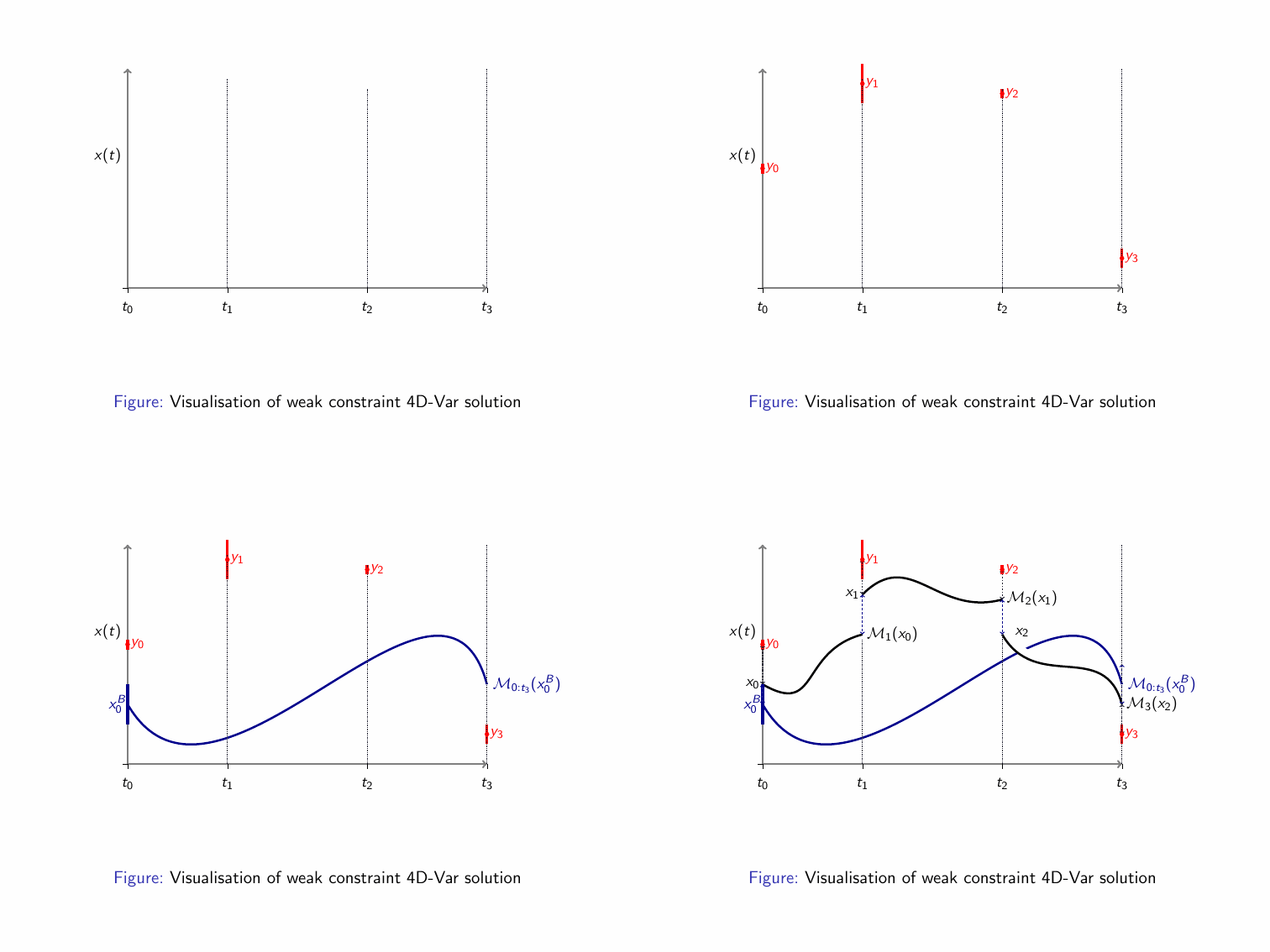
The need to differentiate the model solution process, as well as the observation operators, makes variational data assimilation challenging to implement. Consequently, much DA research is conducted using toy models that sacrifice realism for ease of implementation. Conversely, variational DA remains inaccessible to many simulation scientists as they lack the required derivative (adjoint) model code. Variational DA algorithms have the potential for significant impact in many scientific fields, but the barrier to entry is currently very high.
Firedrake is an automated forward and adjoint PDE simulation system. Firedrake users write high-level mathematical code for their PDE solver, and the resulting high-performance parallel implementation is generated and executed automatically. Further, the adjoint to a forward simulation written in Firedrake is available without further implementation work. This means that efficient forward and adjoint solvers can be created for any PDE, employing a huge range of finite element simulations, all at a tiny fraction of the development effort required using conventional software approaches.
This makes Firedrake a powerful tool for variational data assimilation. DA researchers can easily employ a wide range of PDEs and discretisations to test their work, while simulation scientists gain access to the gradients required to adopt variational DA. Recent work by Dr Josh Hope-Collins, Professor David Ham (Imperial College) and Dr Jemima Tabeart (TU Eindhoven) has integrated the features and computational structure required for weak constraint 4D variational DA within Firedrake in the fdvar library (https://www.firedrakeproject.org/fdvar/).
In April 2026, a Firedrake-DA hackathon took place at Rutherford Appleton Laboratories with the goals of:
- Introducing new users to Firedrake and/or variational data assimilation
- Demos and hands-on experience with the new fdvar library.
- Soliciting community input regarding new features for the library.
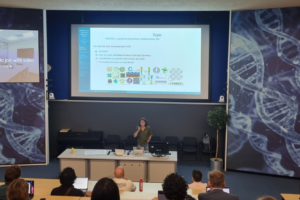
Over three days around 12 researchers discussed and collaborated on each of these aspects. The hackathon started with some introductory presentations by Dr Jemima Tabeart and Prof David Ham on the fundamentals of variational DA and Firedrake. Dr Josh Hope-Collins then discussed how these aspects come together in the fdvar library, and gave some demonstrations of the current capabilities of the library.
Prior to the hackathon, the basic fdvar demo consisted of:
- 1D advection-diffusion problem.
- Simple 1D covariance operators.
- Direct observations on the FEM mesh.
The remainder of the hackathon saw breakout groups collaborate on different aspects to augment the fdvar library capabilities including:
- Applying fdvar to new problems: this included a 2D partial differential equation, and progress towards compatibility with GUSTO (https://www.firedrakeproject.org/gusto/).
- Extension to more physical anisotropic 2D covariance operators.
- More complicated, realistic observation operators (integration along a line).
- Steps towards including new preconditioning strategies within the library.
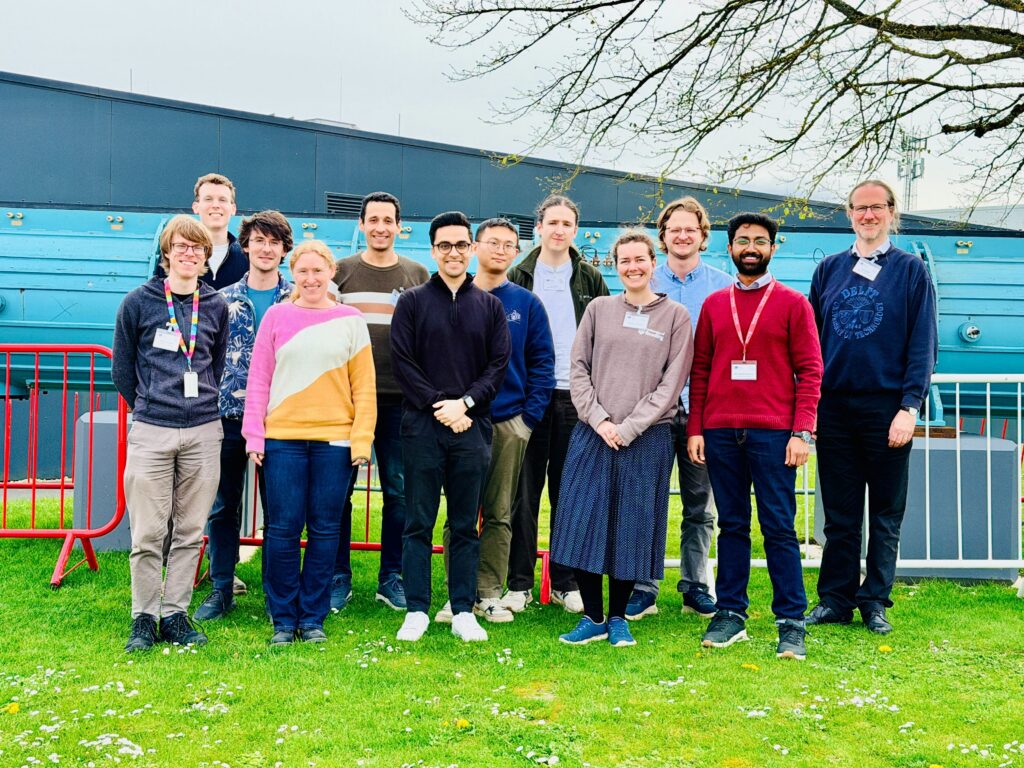
Following the event, an updated version of the demo has been made available for anyone to trial for themselves (https://www.firedrakeproject.org/fdvar/). We plan to augment the demo with new features from the hackathon as they become available.
All in all, the event was a great success in both bringing the fdvar library, and Firedrake to a new audience, and for expanding the scope of its capabilities. Many thanks to all of the participants for making the event lively and very scientifically engaging, and to RAL for hosting us. Dr Tabeart would also like to acknowledge funding from CoSeC via her fellowship, which made the organisation of the event possible.