STEP-UP (Strategic TEchnical Platform for University Technical Professionals) is a UK-based research project funded under the UK Engineering and Physical Sciences Research Council (EPSRC)’s 2023 Strategic Technical Platforms call.
The project is building a regional, London-based, platform to support the development of communities, skills and career opportunities for “digital Research Technical Professionals” (dRTPs), exactly the career type that CoSeC champions as being its core value.
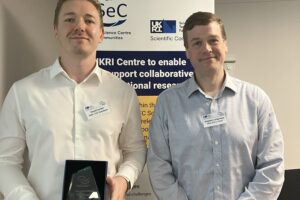
The STEP-UP Conference took place on Monday 29th June at the Francis Crick Institute. Senior Computational Scientist Marcello Puligheddu and I represented CoSeC during the day and the lunchtime poster session. It was fantastic to meet colleagues in other projects that CoSeC champions, including Hidden REF, a campaign which CoSeC supports that is changing research culture by increasing awareness of the vital role of non-traditional outputs (NTOs) and Hidden Roles in the UK and beyond.
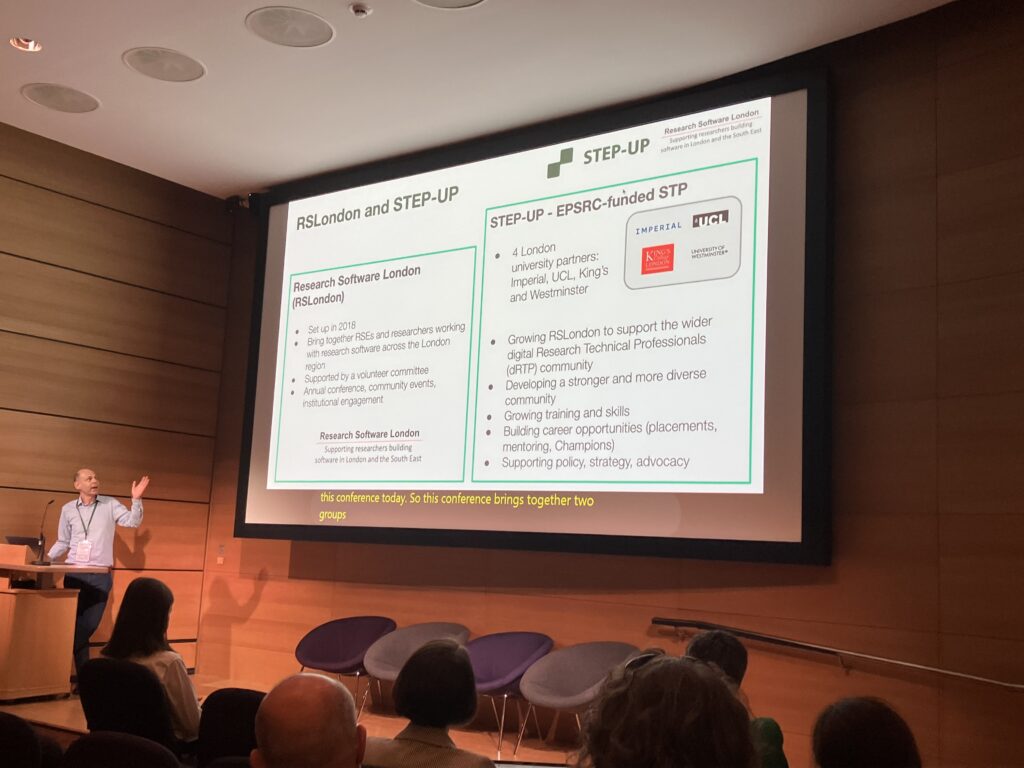
Jeremy Cohen, Imperial College London introducing the conference
Jeremy Cohen, Project Lead and Advanced Research Fellow at Imperial College London with whom CoSeC works with on CAKE, opened the conference, introducing the project core team, led by Imperial with partners UCL, King’s College London and University of Westminster.
The keynote speaker was Dr Leontein Talboom, University of Cambridge Library, a Technical Analyst at Digital Archives. She works on a Transfer service, which has been running for 3 years, with over 800 carriers transferred so far. The University’s records are hugely prestigious including a Stephen Hawking archive, business archive, and a concluded research projects archive.
Currently the Library can process USBs, optical discs, ZIP disks, hard drives, memory cards and floppy disks. Dr Talboom talked about the challenges of transferring, which can be very difficult. Many of the above can be between 30-40 years old, with disks/hardware degrading and knowledge being lost with users getting older and sadly passing away. Systems are not going to get easier over time and many elements make the transfer work not only complicated but also technical. Dr Talboom emphasised that today’s technology is tomorrow’s legacy system and for our audience to bear this in mind when creating and storing software for the future.
Sophie Janacek, Head of Digital Research Infrastructure at UKRI gave an overview of UKRI and DRI, emphasizing skills and expertise available, people and teams’ assessment pilots and the aims behind UKRI funding decisions, highlighting reports on strategic technical platforms and the Zenodo community.
Mahmoud Abdelrazek, UCL, and Rosie Wood, Alan Turing Institute are both responsible for maintaining their GitHubs at their respective institutions. They have worked together on trying tools that can help keep track of the impact of open-source projects and licencing to avoid potential disasters, like projects being abandoned. Analysing 1500 repos, they found the best tool to be UC Repo Finder due to automatic discovery and being simple to use and understand.
Martin Jones, Francis Crick/CCP-volumeEM introduced CCP-volumeEM as one of CoSeC’s newer Collaborative Computational Projects (CCPs), bringing together researchers, microscopists, and software developers across the diverse landscape of volume EM imaging in biology. As acquisition technologies advance, the analytical challenges facing volume EM necessitate handling terabyte-scale datasets, with computational tasks including 3D reconstruction, registration, and segmentation. CCP-volumeEM addresses these challenges through three strands: community building, research software and data management, and training. Martin’s concluding demo of software analysing brain tissue absolutely fascinated the audience and led to lots of visitors to our poster at lunchtime!
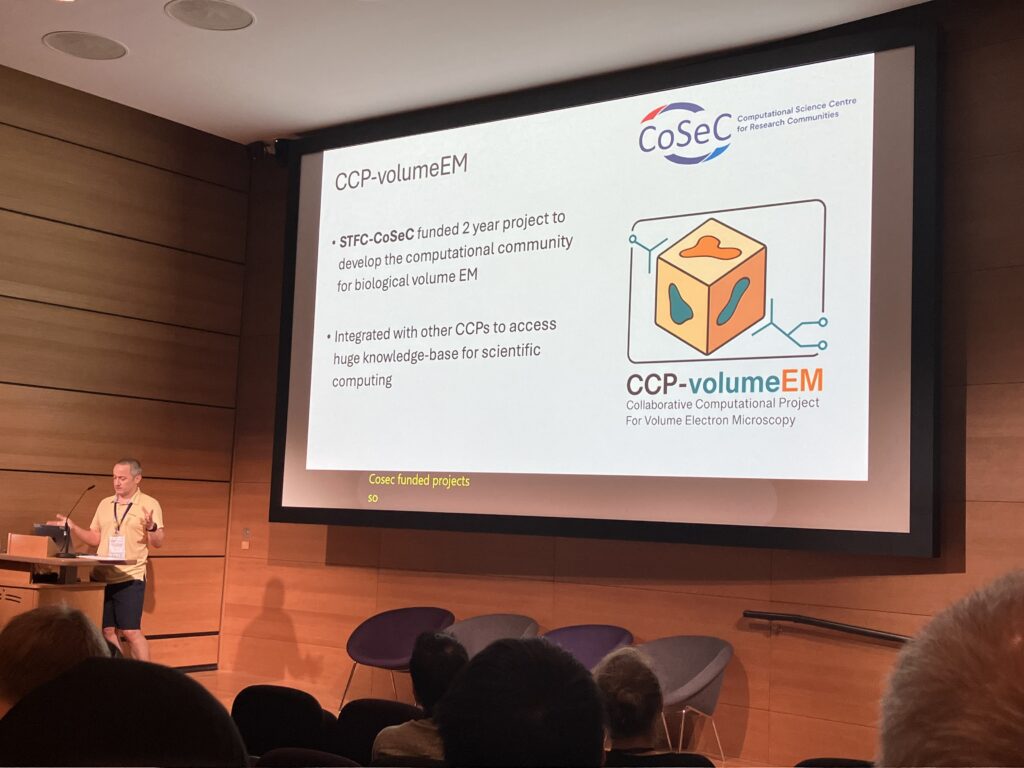
Martin Jones, Francis Crick Institute introducing CoSeC and CCP-volumeEM
Cassandra Gould van Praag, RCM Cooperative
This talk highlighted the role of community management and strengthens the argument that Research Community Managers (RCMs) are an increasingly important component of the dRTP ecosystem. While LLMs and other AI tools are increasingly used to support generation of code, documentation and data processing, they cannot replicate the RCM’s core functions of establishing connections, building trust, helping navigate institutional politics, fostering cross-disciplinary collaboration, and building the socio-technical infrastructure necessary for solving complex problems.
Lightning talks
A series of poster lightning talks then took place to encourage attendees to visit the poster session during lunch, which included.
- Standard open data models from University of Cambridge and MRC, enabling efficiency through standardised culture
- Green Alma – bringing carbon footprint awareness to HPC workflows at the Institute of Cancer Research
- Demystifying HPC – empowering life scientists in HPC use for BioImage Analysis
- Introducing CaSDaR Network – UKRI dRTP NetworkPlus – data curation and community for data stewards
- Technical champions from University of Westminster – identifying digital research bottlenecks and opportunities in the age of AI.
Afternoon sessions
After lunch, parallel sessions took place on data and infrastructure.
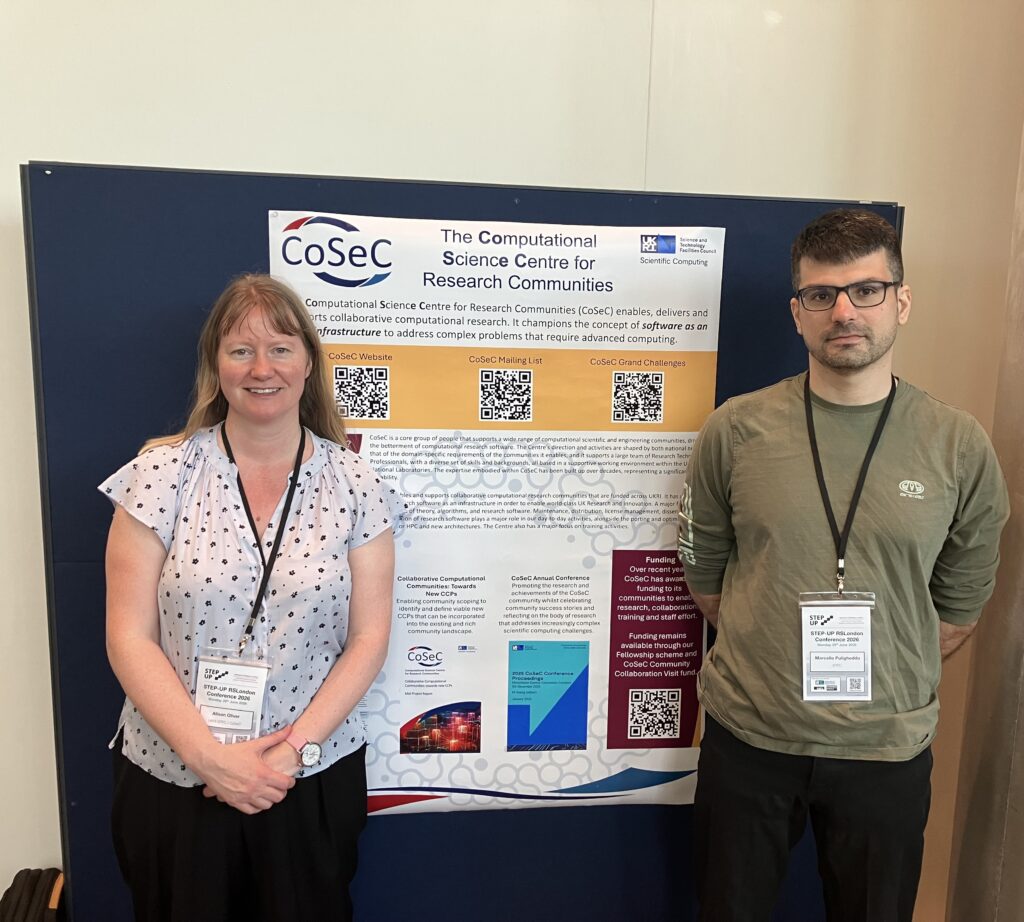
Marcello and I at the Poster Session
Marcello attended the software track talks, which included preliminary results from mapping and evaluating dRTP’s contributions to computing skills and pedagogies in HE; a new framework, called DIRECT, of skills and competencies for dRTPs aimed at helping career development; the portability of using C++20 in R packages; the Python Array API Standard which is a way to standardize how different array libraries work; supply chain security, package management, neuroimaging, FAIR data and web scraping.
I attended the infrastructure talks, which focused on improving the visibility of computing infrastructure with a mini HPC cluster; the UKRI-funded DRIFT project, which focuses on training for dRTPs, particularly Research Facilitators and Research Software Engineers. DRIFT aso has a sister project called CHARTED, the aim of which is to make the training landscape easier for dRTPs to navigate. ACIT Hub introduced their plans for training including bootcamps, hackathons and seminars, as well as other talks on trusted research environments, AI and infrastructure enabling researcher workflows.
It was interesting to see that AI was seen both as an opportunity and concern whn it came to questions from audiences, where speakers would discuss their use within their research and much debate was had on when and when not to trust the results.
With a background in publishing, I particularly found a talk by Stephen Eglen on CODECHECK interesting, which is a system that verifies the computational workflows behind research papers. By checking whether code and analyses can be executed, it helps improve reproducibility and transparency in computational research. Tests across 25 publications showed that integrating CODECHECK into the review process can enhance workflow executability and support Open Science practices.