Introduction
Mark Savill, Cranfield University as Chair opened the forum, welcoming the CoSeC communities to Warwick, covering the actions from the minutes from the previous forum.
CoSeC Director Stephen Longshaw introduced the first day, which focused on updates from CoSeC and DRI across UKRI, as well as including a presentation from the 2025 Impact Award winner, Dr David Lusher, and strategic discussion with communities about next steps.
Highlights since last Community Forum
Highlights since the last community forum in October included CCP-NC migrating CASTEP’s NMR GPU implementation from OpenACC to OpenMP; the development and publication of AI surrogate modelling, including ethical considerations from CCP-WSI; GPU development of ONETEP and Crystal from CCP9, GPU porting of CHAPSim2 for nuclear thermal hydraulics from CCP-NTH, and the development of ML forcefield and potential models enabling quantum accuracy simulation and scalable performance from CCP5. These are just a handful of examples of the hard work achieved by the community over the past six months.
The Grand Challenges have been warmly received by senior colleagues at UKRI, as they pinpoint each community’s goals over the next ten years in tackling the challenges needing to be addressed, in alignment with UK government goals in sustainable computing.
NPRAISE funding and CoSeC Fellows
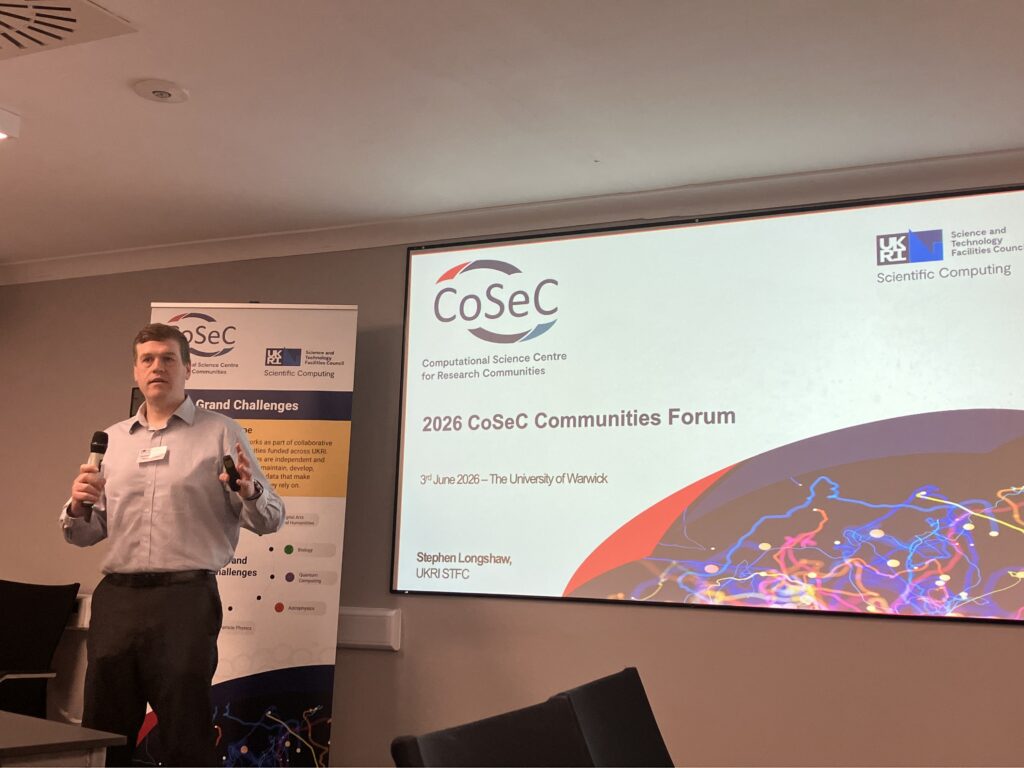
Stephen announced the successful candidates from the NPRAISE funding announcement, for which more information is available here, as well as outcomes from September’s Energy Efficient Computing workshop with a paper almost ready for submission. The team has been invited to WCCM-ECCOMAS 2026 to give a presentation.
Highlights from our 2025 Fellows so far include Jemima Tabeart organising a hackathon held at RAL and Irufan Ahmed attending a conference and his blog about his attendance is available here.
A retrospective look at CoSeC and key drivers
Stephen looked back at the origins of CoSeC in the 1970s, what we have achieved and the key benefits of what we do now. However, he also considered what is missing from CoSeC? Whilst the Grand Challenges have helped pick out higher-level drivers from each community, there is still a disconnect to bridge. What are the specifics that we want to tackle, are these the right top-level outcomes, and what will CoSeC and communities actually do together to enable research software infrastructure for the UK?
CoSeC 2025 Impact Award presentation
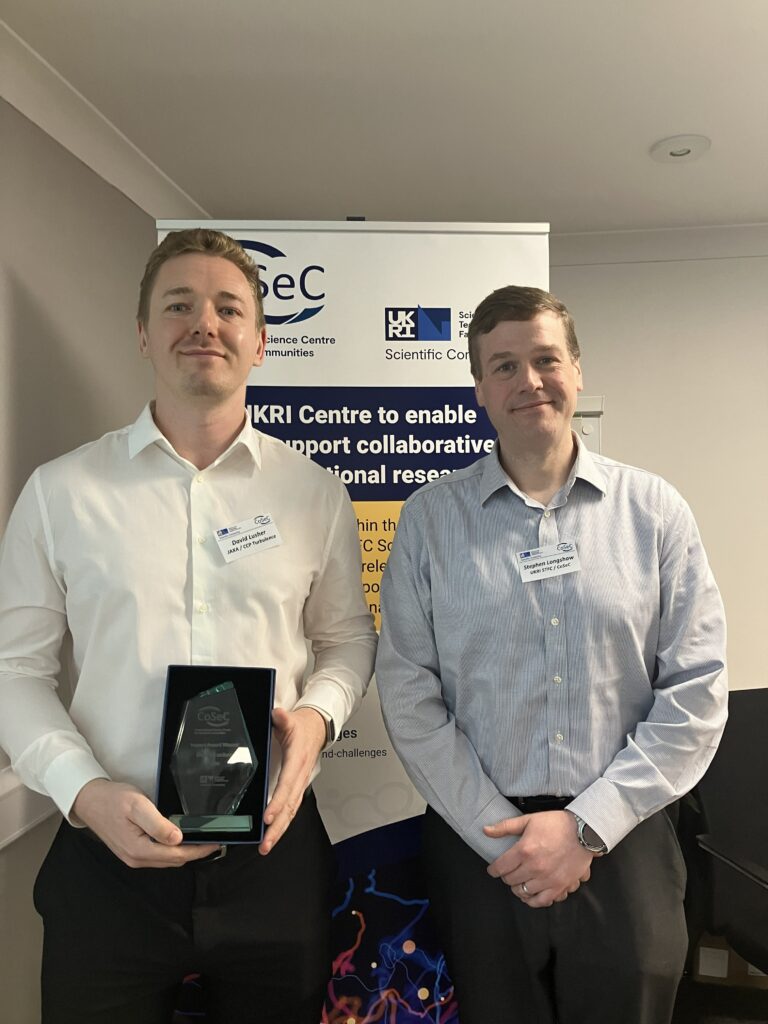
Dr David Lusher, of the Japan Aerospace Exploration Agency (JAXA) then gave a talk about his prestigious work that led to his winning our CoSeC Impact Award for 2025, which recognizes individuals whose work has had a significant positive impact on the scientific community, in close collaboration with CoSeC and the communities we support.
Dr Lusher is the co-creator and lead developer of OpenSBLI, a widely used open-source software package that has become essential for researchers in the field of Computational Fluid Dynamics (CFD). The code is used by researchers and organizations worldwide, and key UK research communities, such as CCP Turbulence and UKTC, who rely on it heavily. You can find out more abut his research here here.
UKRI DRI Council updates
A UKRI DRI Council session was then held with council representatives each giving an update on behalf of their council.
Ben Yarnall then gave a UKRI DRI team update, which included a presentation on the Computational Centres of Excellence.
Applications are open for an Advisory Group for DRI with a closing date of 7th August. The Board will provide independent, expert advice on the delivery of the UKRI’s DRI Programme, including its strategic direction and investment priorities. Applications are welcomed from across academia, industry, policy and wider research and innovation communities.
NNSS will target mission-driven research and support strategic national goals, with a focus on delivering impact. There will be several access routes, including through Grand Challenge consortia (large-scale problems or opportunities in a priority area of national or strategic importance). Software support will be provided to help users with developing and deploying software that is suitable and efficient on NNSS.
Ben introduced new ideas for access models for the future, with discussion groups held about support for the communities.
A forum discussion was then held on CoSeC’s next phases and linking the Grand challenges to the industrial strategy and UKRI compute resources.
On the second day of the forum, Stephen introduced the day, explaining the new format further to discussions with the community and board. The day was divided into four specific topics that cover key areas that our communities are working in.
Energy Efficient Compute – chaired by Adam Greenbank
The aim of this session was to motivate the embedding of energy efficient computing best practices across CoSeC communities, highlight existing work across CCPs and gather feedback on barriers and challenges.
Adam, Jess Huntley and Hussam Al Daas have been seeking to understand issues faced by CCPs relating to green computing, sending out a survey to developers in order to gather information regarding knowledge gaps and technical challenges. An Energy Efficient Computing workshop was held in September 2025 (link), from which a white paper is now being worked on.
Marion Demir from CCP-EM/OxRSE discussed the efficiency of data processing and is currently working on vEM cloud processing. Hyperscale data centres for data storage may be more efficient than internal, with next-gen file formats optimised for processing data. It can enable multi-access read-write and is efficient at parallel processing for multiple data, saving up to 50%. They are considering how to reduce the amount of data generated – sample pre, microscopy, and acquisition strategies.
David McDonagh from CCP4 discussed the vision for Green DiSC, which is to build a new certification scheme which provides a roadmap for research groups and institutions who want to tackle the environmental impacts of their computing activities. For example, David ran an inventory over computer use within CCP4, creating dashboards to monitor usage and attempting to pull down data more efficiently as to when needed to save storage. He welcomed applications to use Green DiSC which sets a common standard across the board, setting a standard of sustainability. Applicants have a chance to help shape the criteria as Green DiSC continues to evolve.
FAIR data – Elizabeth Newbold, Open Science Theme Lead
Elizabeth began by asking why is FAIR important to the CoSeC community and how well is FAIR supported/implemented in the respective communities?
FAIR data enhances research integrity, maximises value of research investments, supports responsible data sharing and reuse, facilitates collaborations, and enables digital transformation. FAIR data turns scientific data from a one-time project output into long term scientific infrastructure.
However, implementation and what those goals mean may be different in practice. Software requires additional layers, so how can FAIR data and software work together?
FAIR at the WSI community – Wendi Liu
WSI community supports the UK Wave Structure Interaction (WSI) related computational research and engineering activities. FAIR principles are central to ensuring sustainable, reusable and impactful computational research.
For a highly multidisciplinary community with many software tools and workflows, FAIR is what enables community members, codes and data to work together effectively. A key FAIR initiative within the community is the CAT-WSI catalogue (https://ccp-wsi.ac.uk/catalogue/). Developed over the past few years, the catalogue serves as a rich community resource that connects projects, test cases and software adopted. The search capability of CAT-WSI enables enhanced discoverability, gaps in the community to be identified and potential repetition reduced.
The key challenges for FAIR in the WSI community come from both the technical and sustainability aspects. Technical challenges include finding hosts for large-scale HPC datasets and cataloguing emerging tools such as trained AI models. Sustainability challenges include funding for maintenance and curation, domain knowledge requirements in keeping repositories and catalogues up to date, training researchers in FAIR and software engineering practices, handling outdated training materials and aligning with the latest policy of trusted research and export controls.
Nuclear Thermal Hydraulics Data & FAIR Principles – Wei Wang
Wei Wang presented the Reactor Vessel Auxiliary Cooling System (RVACS) as a case study demonstrating the value of FAIR data principles in computational science. RVACS is a passive safety system designed to remove decay heat from a nuclear reactor vessel without pumps, active controls, external power, or operator intervention.
The RVACS benchmark provides a common reference problem for reproducible research. Multiple organisations independently simulated the same system using different Computational Fluid Dynamics (CFD) codes and modelling approaches, enabling objective comparison of results and assessment of reproducibility. By sharing a common geometry, boundary conditions, material properties, and output metrics, the benchmark establishes a consistent basis for cross-code validation and comparison.
Wei highlighted that FAIR data extends beyond simulation outputs alone. To be truly reusable, datasets must also include the modelling assumptions, geometry simplifications, metadata, and workflows used to generate the results.
By making benchmark datasets findable, accessible, interoperable, and reusable, FAIR principles transform a one-off simulation campaign into a long-term community resource. Such datasets can support reproducibility studies, code benchmarking, uncertainty quantification (UQ), and future AI and machine learning applications in Nuclear Thermal Hydraulics.
FAIR in BioSim – Sarah Harris
True reproducibility/interoperability needs an aggressive approach at the software development stage. Findability and accessibility for biomolecular simulations would be a huge step forward, and biology already has a strong precedent for both (e.g. experimental structural and sequence data).
Priorities so far include aggregating simulation data into high quality, organised and well curated databases fit for consumption by other researchers, and incentives for wide adoption of any potential data-sharing platform, and ease of use. An early success is the BioSimDB prototype aligning with community members values and needs, with strong links into international efforts such as MD4SB (MDDB).
Historically, we have had large investment in compute capability but no emphasis on data or where it can be stored, which leads to data loss. FAIR requires more skills and investment in the short-term, but huge benefits over the long-term. Data repositories need to be long-term and a cooperative endeavour, requiring community rather than competition between teams.
AI – Jeyan Thiyagalingam, CCP-AHC Project Lead
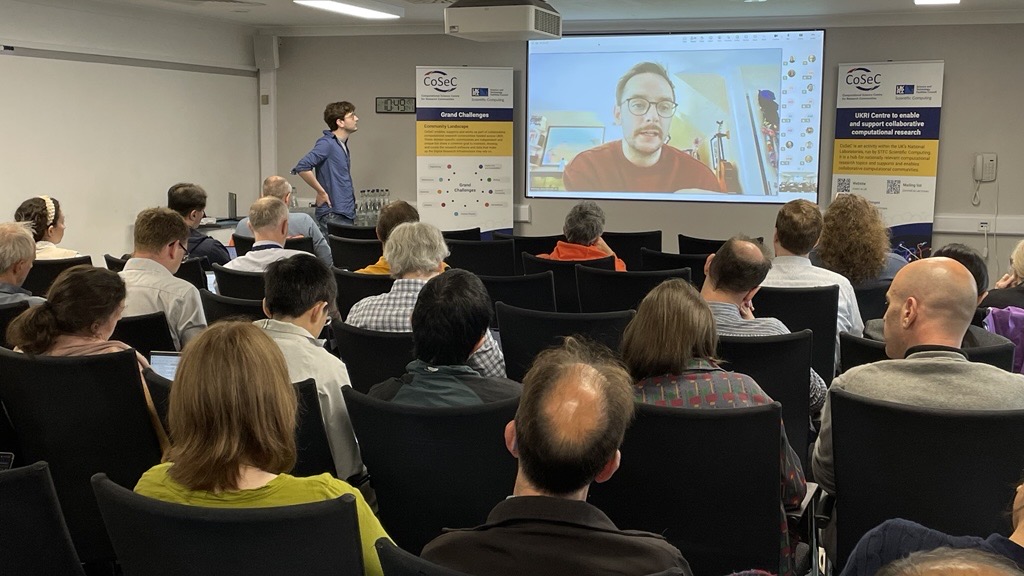
This session explored how AI is used across the communities with a series of presentations from communities with differing levels of experience of AI. The session also included an open panel discussion.
The past decade has accelerated almost all of the single steps in scientific computing: denoise, fit, classify, etc. AI in science and engineering covers areas that are insanely data-rich (simulations and data experiments) and instrument-bound (e.g. beamlines).
We now have closed-loop experiments that steer beam time in real time. One sample measured across two beamlines at once. The shift is about online analysis that redirects the experiment while it runs.
AI is currently used in materials science, biology, and earth science, such as global weather forecasts in seconds, not hours. Where CoSeC fits is how these foundational models are further developed, tuned or distributed amongst various CCPs and HECs.
Agents do the thinking – AI scientists are Google AI Co-Scientist, Stanford Virtual Lab, Aakana AI, which are strong at hypothesis generation but weak on rigour and ground truth. But they should be watched closely and trusted cautiously.
Coding agents are spec drive, with real RSE productivity. Multi-agent pipelines now write, debug and validate solvers end to end. Code quality vs runtime performance vs productivity vs maintainability. AI can start another equation straightaway after solving one, which is tempting to accept but one must still be cautious and double check the data.
AI is moving from accelerating steps to running the cycle. Science, engineering, and experimental facilities are becoming the proving ground of AI autonomy.
AI for Arts, Humanities, and Culture in CCP-AHC – Eamonn Bell
CCP-AHC’s main goal is to widen engagement with DRI by UK based researchers and innovators. AI in the community at this moment consists of mostly the use of pre-trained natural language and computer vision models, with a skills gap amongst novice users. CCP-AHC’s Grand Challenge is to widen access to public compute to unlock computational analysis of arts, humanities, and culture sources. Eamonn described work currently underway, such as Katherine McDonough’s (Lancaster University) continuing work on MapReader and the work of Giles Bergel (University of Oxford) to promote a multimodal AI search interface for multimedia collections that was developed at the Oxford Visual Geometry Group (VGG).
Eamonn also described CCP-AHC’s work in speech recognition workflows – 100,000s of hours of recorded oral history held by UK GLAMS are not yet searchable, so they have developed a simple workflow showing open-weight (OpenAI Whisper) inference and the LLM-as-critic in the Galaxy workflow manager project. This is effectively lowering barriers and promoting FAIR research. Ethical, legal and social issues are critical, and CoSeC’s work could bridge gap with other UKRI-funded work on appropriate uses of AI, as well as copyright and environmental sustainability. Looking forward, Eammon discussed plans for coalitions and containers; local/edge inference, agentic coding using LLMs for low-risk software prototyping; and working to understand the advantages that hyperscalers bring to compute in terms of developer/user experience.
AI for Materials & Molecular Modelling – Alin M Elena
Machine Learning in the materials modelling have revolutionised and transformed the field in the last fewyears. Based on availability of good data from computations and/or experiment one can use machine learning to train expert systems using large language models (a la chatGPT), train surrogate models to predict properties or structure avoiding the use of simulations or simply speed up simulations by using machine learnt interatomic potentials (MLIPs). Our group is dedicated to making possible the creation of these models by providing data infrastructure, workflows for creation and exploitation of machine learnt models.
Machine Learning applications in materials modelling saw a big adoption and increase in methodologies it offers n the last five years. the diagram shows how one can go from data to better science, faster science or newer science
via machine learning in the field of materials modelling. Everything starts with data, with four branches where AI has made an impact – name, paper, input files; structure; computed properties; and experimental properties.
In Materials Science, AI generative models create new molecules and sampling new configurations replace MD or MC and is used to speed up electronic structures.
AI in materials landscape has lately expanded to the use of generative models to generate new molecules and materials, as well as new configurations for sampling that totally skip the need for molecular dynamics or Monte Carlo. Progress has also been made in rare events sampling and using AI for collective variables definitions. Of course, AI is also used for vibe coding and for image generation.
Physics Informed Neural Operators – Dr (Yiyun) Raynold Tan, Hartree Centre
Wave–structure interaction (WSI) simulations are highly complex, involving multiple physical processes and significant computational expense. To tackle these challenges, Dr (Yiyun) Raynold Tan is investigating the use of artificial intelligence to accelerate and streamline these simulations. As part of this initiative, a hackathon is scheduled for July to build AI expertise within the CCP-WSI community and encourage the uptake of advanced machine learning methods.
The work centres on neural operators for efficiently approximating solutions to governing equations, particularly through the development and evaluation of graph neural operators (GNOs) with tailored loss functions. These approaches have been tested on focused wave interactions with floating structures, a demanding and representative WSI case. The results indicate that the GNO model can reproduce the pressure Poisson equation (PPE) with reasonable accuracy, highlighting its potential for speeding up multi-physics simulations. Overall, the use of a combined loss function—incorporating data, gradient, and PDE losses—has been shown to improve spatial consistency and enhance model performance.
Quantum Computing – Martin Plummer, Computational Scientist
This session provided an introduction to quantum computing with three presentations based around current work and a Q&A session. A separate Quantum Algorithms Day was held the following day.
CCP-QC research is focussing on three main subjects – computational materials physics, computational mathematics contribution to quantum algorithms and the quantum lattice Boltzman method.
Green function approaches offer better estimations in photo emission spectroscopy and self-energy. ‘GW’ approximation for the self-energy has been shown to be a good approximation to improve the band gaps from DFT calculations of materials. GF can be implemented in quantum computing by using variational quantum simulation algorithms which can be using for simulating the dynamics of quantum systems. It extends the Variational Quantum Eigensolver approach to study time dependent phenomena and solves problems in quantum physics and chemistry. A workshop is upcoming on CECAM-PSI K in Glasgow in early July and further details are available here.
CCP-QC will be applying for time on a quantum computer, implementing the Lanczos method for excited states, which uses QC for calculations of moment cumulants. Also, they are putting together an application for a CERN hackathon which will help students learn about quantum computing and density functional theory.
Kathryn Lund and Steph Foulds – Bridging gaps between computational maths and quantum algorithms
Kathryn Lund and Steph Foulds are working on reversing state preparation algorithms to improve read-out, using the language of inverse problems to understand error pipeline and employing QC in preconditioning iterative methods. They are also engaging in outreach activities, including a quantum numerical linear algebra reading group which ran from September 2025-March 2026 and a workshop this September to engage interest in computational maths and quantum algorithms.
Scott Woodley – MCC representing Bruno Camino
The MCC is interested in whether it is worth investing effort into trying to exploit quantum computers and/or related hardware.
Bruce and his colleagues have derived an innovative approach to calculating the thermodynamics of disordered materials (such as alloys and doped systems) using quantum annealing, along with developing a suitable workflow to achieve this. This is proof of concept as the size of the system under investigation (number of atoms in the supercell) is restricted by the connectivity of physical qubits in the hardware.
Zhengliang Liu – Quantum Lattice Boltzman Method
LBM is a mesoscopic method that simulates fluid flow through distribution functions on a discrete lattice. They proposed a complete QLBM based on a linear equilibrium model.
Chair Mark Savill closed the forum, saying this first tryout for a new format with the use of slidos proving a successful combination for a productive meeting. The next will be online only and half a day in six months