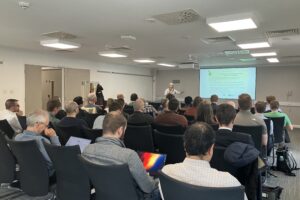
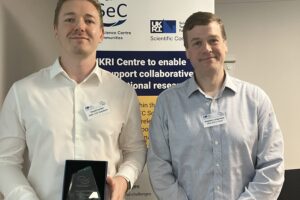
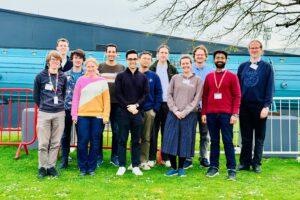
Hosted at St Anne’s College, University of Oxford from 14th-15th September 2026, CCP-WSI Project Lead Deborah Greaves opened the conference, explaining the aim to bring together the CCPs of the CoSeC community, involved in engineering – CCP-NTH, CCP-QC, CCP Turbulence and CCP-WSI to explore further opportunities to collaborate in what is hoped to be the first in an annual series of conferences.
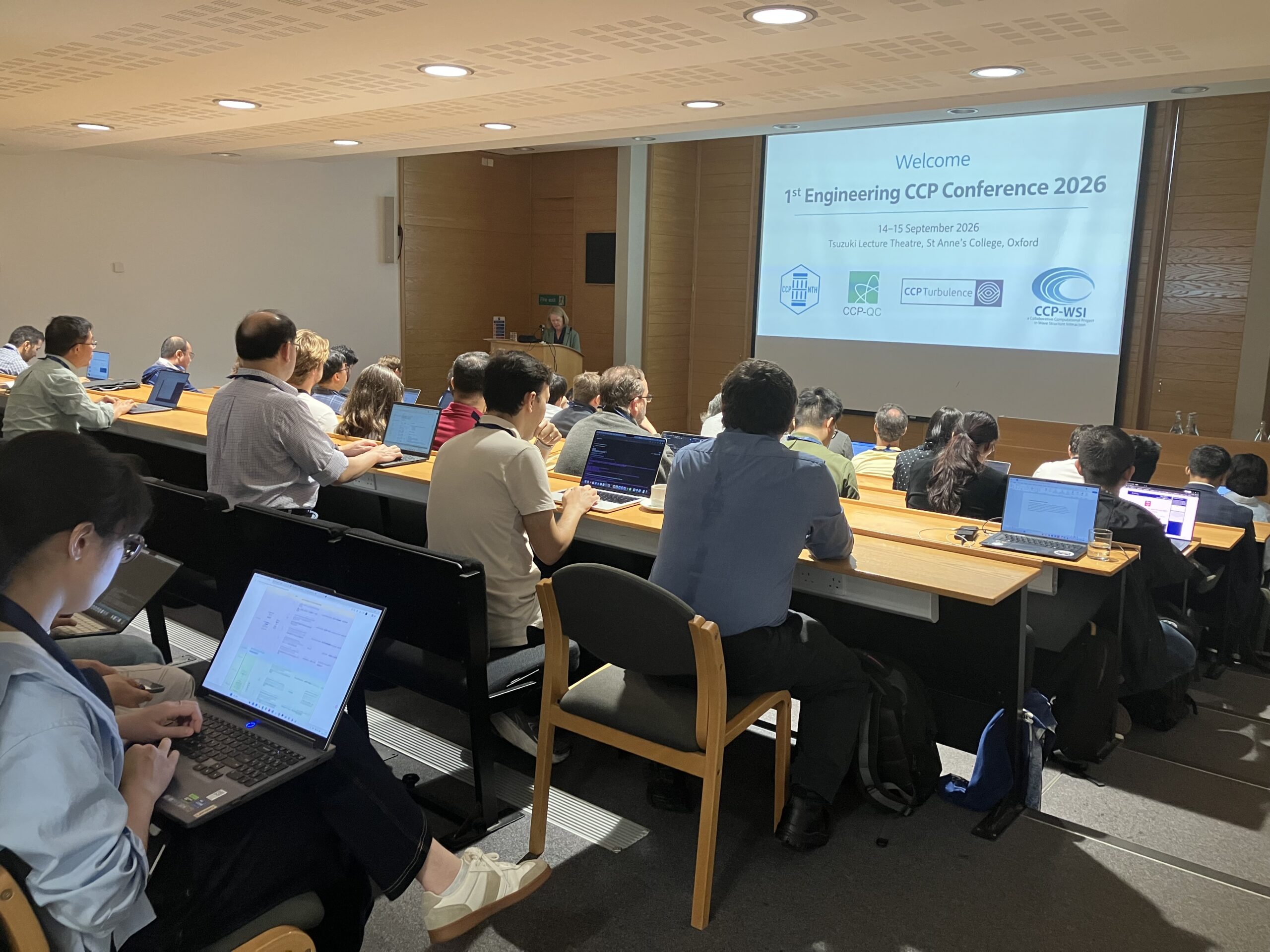
CCP-WSI Project Lead Professor Deborah Greaves, University of Oxford opening the conference
Keynote speaker Neil Ashton, NVIDIA Distinguished Engineer, explored how accelerated computing and machine learning are reshaping engineering simulation. He highlighted how GPU-driven computing is expanding what is economically feasible, while surrogate models are now accurate enough to deliver value for familiar use cases. AI agents already assist with setup, monitoring and code porting, but their limitations in handling physics mean they still require robust validation. Trust comes from combining fast GPU solvers, validated surrogates and experimental verification.
Chaired by CCP Turbulence and UKTC Project Lead Dr Stefano Rolfo, the morning session focused on the theme, GPU-Accelerated Computing and Performance Portability.
Dipanjan Majumdar (Imperial College London) presented GPU-enabled uDALES, an open-source urban large-eddy simulation tool for modelling airflow, heat transfer and pollutant dispersion. Chong Ma (National Maritime Research Institute, Tokyo) discussed a GPU-accelerated HOS-SPH coupling model that enables efficient 3D simulation of extreme waves.
Dr Wei Wang (CCP-NTH) showcased GPU porting of CHAPSim for turbulence and heat transfer simulations. Mayank Kumar (CCP-WSI) highlighted how GPU-enabled OpenFOAM is accelerating community workflows, while Benedict Rogers (University of Manchester) presented performance-portable SPH using Kokkos and Cabana. Led by student Chunze Cen, this work has sparked an ongoing collaboration with EPCC.
The second keynote, delivered by Dr Aleksander Dubas (UKAEA), explored the role of high-fidelity multi-physics and multi-scale simulation in fusion energy. He outlined how advanced coupled simulations are helping tackle the complexity and uncertainty of fusion component design and encouraged the community to engage with UKAEA’s open software tools.
A further round of lightning talks covered PETSc offloading for industrial CFD, AI-driven wave-structure interaction modelling, barge motion prediction using AI, and sloshing dynamics in baffled tanks.
The afternoon session focused on AI/ML, visualisation, and data-driven methods. Andrew Mole (Imperial College London) demonstrated how flexible turbine blades can alter optimal wind farm configurations and reduce power output. Harriet Jones (STFC) presented an HPC image-based simulation pipeline using code_saturne, showing how software can help tackle the growing challenge of next-generation imaging datasets.
Dr Raynold Tan (CCP-WSI) presented work on accelerating wave-structure interaction simulations using graph neural operators, followed by Jony Castagna (Hartree Centre), who in turn, explored the application of graph neural networks to model the time evolution of single- and multiphase transport equations.
Afrah Farea (University of Oxford) discussed visualisation tools for training physics-informed neural networks (PINNs) as PDE solvers, demonstrating how improved insight into training dynamics can enhance interpretability, explainability, and problem diagnosis.
Closing the day, Leo Rangheard (University of Plymouth) showcased a pipeline for real-time visualisation of time-resolved CFD data from floating offshore wind turbine simulations, generated using OpenFOAM.
Day two opened with sessions on multiphysics, particle and interfacial flows, chaired by Jun Zang (University of Bath). Harish Viswanathan and James Entwistle (Sheffield Hallam University) presented advances in fluid dynamics modelling, from inertial drop coalescence simulations to improved red blood cell interaction models using the Lattice Boltzmann method. Benedict Rogers continued highlighting his work with student Chunze Cen on SPH approaches for temperature-dependent surface tension, while Valantis Tsinginos (CCP-ParaSolS Project Lead) introduced OPS-Particle, a domain-specific language for particulate system modelling. Talks from Suvijack Maneegoolpunt and John Morrissey showcased research into sloshing dynamics and particulate solids simulation.
Poster lightning talks on day two covered topics ranging from breeder blanket thermal hydraulics to methane source inversion.
The final keynote, delivered by Francesc Xavier Trias Miquel (Universitat Politècnica de Catalunya), challenged delegates to rethink CFD for modern HPC architectures.
The late morning session on DNS/LES and high-fidelity flow simulation opened with Raima Rahman and Denis Kuropatkin (Queen Mary University of London), who presented a multi-fidelity framework for analysing low-Reynolds-number contra-rotating wind turbines. Their work establishes a compact hierarchy of models that bridges rapid rotor prediction with high-fidelity CFD wake analysis.
Raahil Sanjay Nayak (Sheffield Hallam University) presented his PhD research on cooling strategies for hypersonic boundary layer flows using DNS, with future work set to explore the effects of shock waves on boundary layer behaviour. Donggang Cao (UWE Bristol) discussed IDDES simulations of turbulent spray flame evolution, demonstrating how a Lagrangian-Eulerian framework can successfully capture complex spray-turbulence-chemistry interactions.
Zekun Ma (University of Warwick) presented direct numerical simulations of linearly accelerating turbulent channel flow, showing that the acceleration process progresses through four distinct stages and highlighting the potential of internal shear layers as indicators of turbulent patches. Closing the session, Will Biddles (University of Warwick) shared high-fidelity LES studies of flow around an Ahmed body, revealing that ground conditions have a significant influence on flow behaviour and aerodynamic characteristics.
Lige Zhao (University of Oxford) opened the final session on Offshore Wind, Turbines and Marine Systems, with a talk on breaking wave properties in deep-water sea states. Hamid Sarlak (TU Delft) presented benchmark data for floating wind platforms, highlighting their potential to promote wake recovery. Kalina Karadimova (University of Plymouth) discussed offshore hybrid platforms incorporating the use of nets for fish farms within floating platforms for the Celtic Sea.
Sithik Aliyar (TU Delft) showcased SWENSE-based CFD, a faster approach for floating wind turbine wave-structure simulations, while Sa Zhu (University of Oxford) concluded the day with research into how blade root pitch offsets influence tip-vortex pairing and near-wake evolution in wind turbine wakes.
Closing the conference, Deborah Greaves handed out prizes for the posters and thanked all for coming and the organising committee, remarking that this first conference was “a great success and fascinating to learn about all the new areas, the same challenges we faces, our different approaches to these challenges and how we are trying to tackle them. We have thought together across different disciplines, and that has been an enriching experience for us all to learn and make new collaborations.”