Dr. Jian Fang, Senior Computational Scientist in the Computational Science and Engineering Division shares his vision for the significance of high-performance computing in hypersonic engineering
Hypersonic flight means flying faster than five times of the speed of sound (Mach≥5), which would largely cut down inter-continental travelling time and make a global same-day return trip possible. However, hypersonics raises huge challenges to engineering-related aerodynamics, such as aerodynamic heating, which led Dark Star to be disintegrated at Mach 10.4 in the movie Top Gun 2 (in reality Tom Cruise would be immediately killed by the hypersonic incoming flow), ignition and stable combustion in case of supersonic flows, and discontinuities of the flow field due to strong shock-waves, for instance. Unlike conventional aircraft engineering, which relies a lot on wind tunnel and ground experimental tests during the design process, hypersonic wind tunnel testing is extremely difficult and expensive. Therefore, Computational Fluid Dynamics (CFD), nowadays heavily supported by high performance computing (HPC), has never been so important to hypersonic engineering.
On the one hand, academic CFD methods, such as, direct numerical simulation (DNS) can provide detailed and accurate information of the flow field and help researchers to understand the flow physics. This kind of method has been adopted by academics since the 1980s. On the other hand, engineering CFD methods such as simulation based on the Reynolds-averaged Navier–Stokes (RANS) equations, can rapidly predict the flow field around an aircraft and provide engineers critical data to design vehicles. RANS modelling has been playing an essential part in the aerospace industry since the 1990s because a significant problem of DNS is that it is too computationally costly and limited to the study of only fundamental problems. However, RANS simulation, although it is cheap to do, is sometimes not reliable enough and the primary reason can be attributed to the uncertainty caused by turbulence modelling which relies heavily on human’s knowledge on flow physics and empirical data.
For hypersonic vehicles that would operate in a wide range of speeds and altitudes, the problem becomes more important. Many multi-physics and multi-scale problems have to be taken into account in CFD, such as the appearance of shock-waves, the rarefied gas effect, and the non-equilibrium chemistry for instance. All of these effects are mixed up together and interact with each other, and therefore have to be accounted for in CFD simulations. Up to these days people have very limited understandings about how these effects impact the hypersonic vehicle performance and the engineering prediction is far beyond reliable.
In the computational engineering group (CEG) at STFC Daresbury Laboratory efforts are being made to push the current boundary of CFD towards hypersonics. The high-order CFD solver ASTR code which has been developed in-house and applied to studying shock-wave/boundary layer interactions (see the animation from the DNS of shock-wave/boundary layer interaction of the scramjet) is currently being upgraded to account for more physics targeting simulations of high-Mach hypersonic flows. It includes adding the method of moments for the rarefied gas effect method that has also been developed within the CEG and a reactive module to include chemical reactions. The ultimate objective is to develop high-fidelity CFD software able to tackle multi-physics multi-scale problems around hypersonic vehicles.
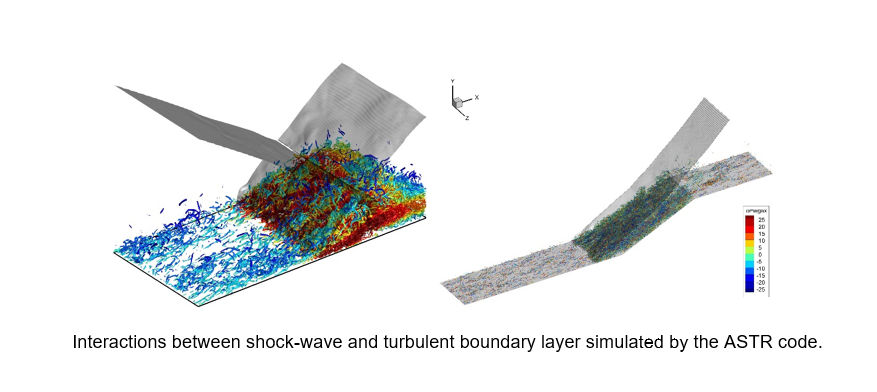
Interactions between shock-wave and turbulent boundary layer simulated by the ASTR code.
I am also currently carrying out some fundamental research in hypersonic aerodynamics that includes turbulence modelling relying on machine learning. The long term prospective is to support the UK hypersonic community with an advanced dedicated CFD software that will include a strong knowledge in hypersonic flow physics, reliable computational models, and excellent parallel efficiency.
The study of shock-wave/boundary layer interaction in the interneral flow of a mode scramjet
Contact: Jones, Damian (STFC,DL,SC)