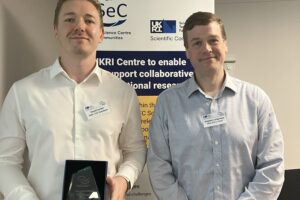
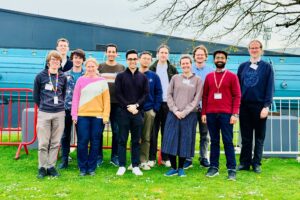
Supported by CoSeC, the 17th ERCOFTAC SIG 33 Workshop on Flow Instability, Transition and Control recently concluded in Vigo, Spain (May 25–27, 2026). The event served as a global forum for advancing both fundamental and applied fluid mechanics research.
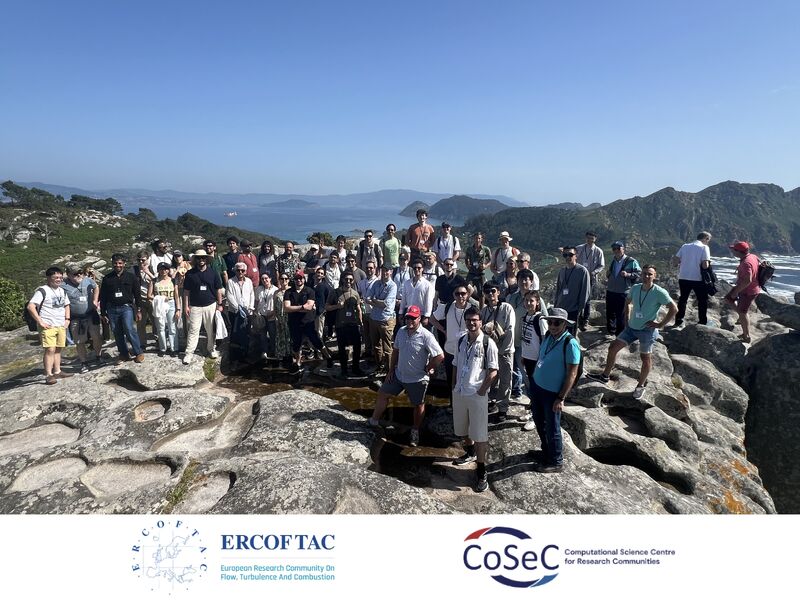
The workshop featured over 40 talks from leaders in transition, control, stability as well as machine learning, and material science (the book of abstacts can be found on the event website). The Keynote talks featured:
- OWNS, NOWNS, and Unknowns: Efficient and robust tools for transition prediction — Tim Colonius (Caltech)
Prof. Colonius introduced the One-Way Navier–Stokes (OWNS) and NOWNS frameworks. These streamwise-marching tools provide a computationally efficient alternative to expensive global stability methods, enabling accurate transition prediction in the complex geometries and hypersonic flows critical for modern aerospace design - Differentiable flow solvers and online learning for the dynamical systems view of turbulence — Jacob Page (University of Edinburgh)
Dr. Page detailed the power of “online learning,” where differentiable flow solvers are embedded directly within neural network training loops. This approach has revolutionized unstable periodic orbit discovery and state estimation, producing more stable numerical schemes than traditional “offline” data-driven methods. - From wall impedance to fluidic crystals: Metamaterials for Controlling Boundary Layer Instabilities — Marios Kotsonis (TU Delft)
This seminar explored the use of engineered composite structures to suppress boundary-layer instabilities. Prof. Kotsonis demonstrated how Tollmien–Schlichting waves could be attenuated utilizing metamaterials, offering a new paradigm for passive flow control that goes beyond what is possible in nature. - Model reduction and control of Flows over complex and responsive Surfaces — Shervin Bagheri (KTH)
Prof. Bagheri addressed the complex interactions between fluids and responsive surfaces, such as bacterial biofilms and lubricated walls. His talk highlighted progress in capturing the strong coupling and feedback that occurs when a surface evolves dynamically in response to the flow it supports.
The workshop also highlighted several powerful open-source toolboxes essential for stability and sensitivity analysis, including:
- Nektar++: A spectral/$hp$ element method used for gap discontinuity simulations.
- BROADCAST: A high-order compressible CFD toolbox utilizing algorithmic differentiation.
- GetFEM: An automated finite element library for complex fluid-structure interactions.
- nekStab: A tool for the stability analysis of non-homogeneous incompressible flows.
- DeHNSSo: A harmonic solver for nonlinear stability in complex geometries.
Overall, the 17th SIG 33 Workshop underscored that the future of fluid mechanics lies at the intersection of high-fidelity physical simulations, advanced experiments, and adaptive, data-driven modeling and control.